
About OrbitTest
QA automation that stays close to the user story.
OrbitTest is a browser, Android, and API testing platform for teams who want automation to be readable, explainable, and useful in real product work.
- Intent-first tests
- CI-ready evidence
- Android Studio workflow
- API testing workspace
- Open documentation
- Browser automation
- Mobile evidence
- API workspace
- Reports and traces
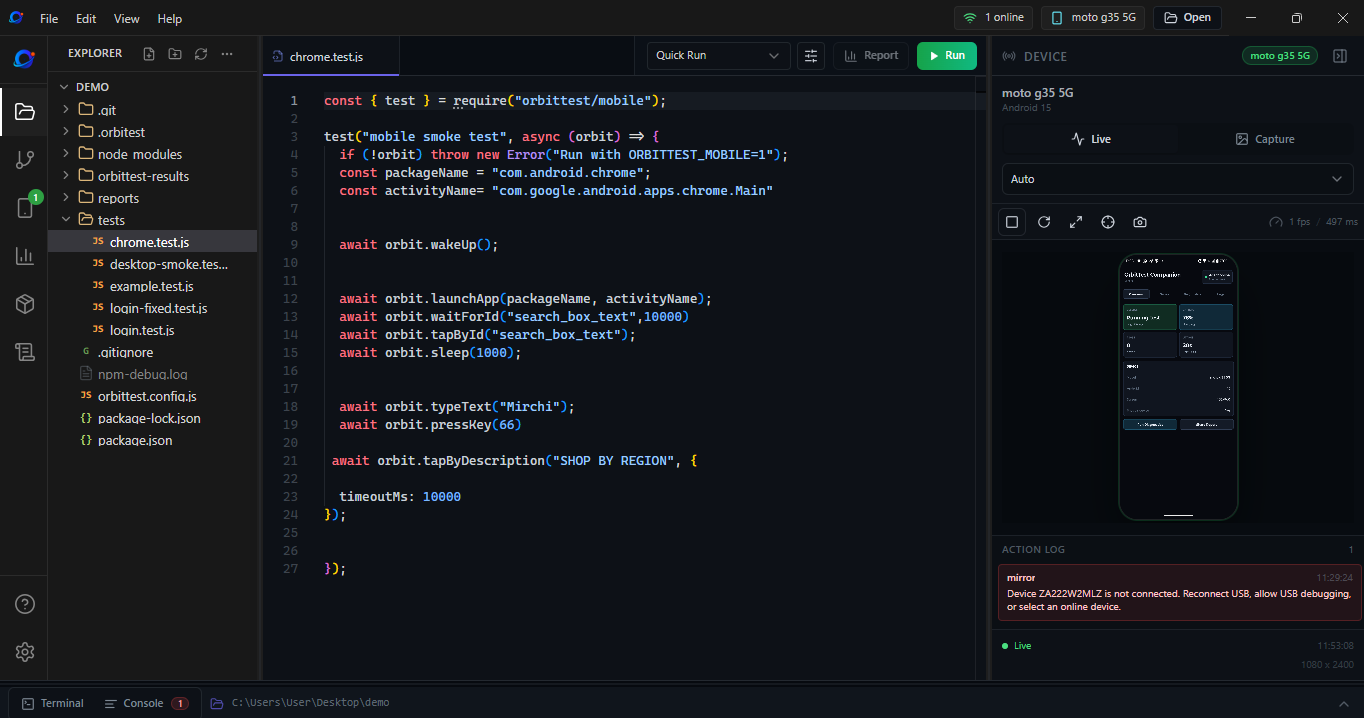
Tests should describe what a user can see, click, type, and verify.
Failures should come with reports, screenshots, traces, logs, and enough context to act.
The project spans web flows, local CI runs, Android devices, Studio workflows, and the Orbittest Client API workstation.
Every major feature should be explained like a practical QA handbook.
Why It Exists
Less selector maintenance. More product signal.
Modern teams ship fast, but end-to-end tests often fail for reasons users never experience. A class changes. A DOM wrapper moves. A selector becomes stale. OrbitTest is built around the opposite bias: test what the user-facing product communicates first.
The project brings together intent-first browser automation, practical CLI behavior, reports, traces, Android device workflows, OrbitTest Studio, and the Orbittest Client API workstation so QA engineers and developers can move from failure to explanation faster.
System Model
One workflow from test idea to failure evidence.
OrbitTest is designed like a loop: define behavior, automate the flow, run it locally or in CI, inspect evidence, and improve the suite without hiding intent behind framework ceremony.
Start from labels, roles, visible text, and user journeys.
Use browser, mobile, environment, and CI configuration deliberately.
Keep reports, traces, screenshots, logs, and failed request details close to the run.
Use failures to refine product coverage instead of accumulating brittle checks.
The Journey
From brittle browser checks to a broader QA platform.
OrbitTest has grown as a sequence of practical steps, each one aimed at removing a real source of friction from everyday testing work.
01
The repeated pain
Browser tests were too often tied to hidden implementation details. A working user flow could still fail because a selector changed.
02
The intent-first core
The first milestone was a Node.js testing API that resolves visible labels, roles, and text through Chrome DevTools Protocol.
03
Useful failure evidence
OrbitTest added structured reports, traces, screenshots, console diagnostics, failed network request capture, and CI-friendly output.
04
Faster authoring
Forge Recorder and the local UI dashboard made it easier to create tests, inspect runs, and move from manual exploration to repeatable automation.
05
The Android chapter
The mobile provider and OrbitTest Studio expanded the workflow to Android QA with ADB, UIAutomator, device mirroring, logs, and an IDE-style surface.
06
The API chapter
Orbittest Client added a local-first API testing workstation — send requests, inspect responses, catch contract drift, mock APIs with the Ghost server, and run data-driven suites, all on your machine with no account or cloud.
Principles
Built for clarity, local control, and practical QA work.
Readable by default
Tests should be understandable by QA specialists, developers, and product-minded teammates.
Evidence over mystery
A failed run should explain the failure path with artifacts a team can inspect.
Small, useful surface
The API should stay direct and focused on real automation problems instead of needless ceremony.
Built by Abhay Kumar
A practical project shaped by QA engineering pain.
OrbitTest is built for the kind of testing work that happens under release pressure: unclear failures, changing UI, mobile device friction, and the need to explain quality risks quickly.