Open any app on your phone and tap something — check a delivery, load a feed, log in. None of that actually happens inside the app. The screen is just displaying one side of a request-and-response conversation with a server, and that conversation runs over an API.
Which leads to an uncomfortable truth: a broken API doesn’t always look broken. The interface can render perfectly — buttons in place, animations smooth, no error toast — while the data underneath is stale, missing, or silently wrong. A cart badge can tick up to 3 even though the server still thinks it’s 2. Users never experience “the API returned a malformed payload.” They experience “the app lied to me.”
That gap between looks fine and is fine is why testing at the API layer carries at least as much weight as testing what’s on screen — and why automating it has become table stakes.
Quick answer: API testing automation is the practice of using scripts and tools to automatically verify that an application’s APIs return the correct status codes, data, and performance — without a human sending each request by hand. It runs continuously inside CI/CD pipelines and catches breaking changes within minutes of a code push.
Table of Contents
- Where API Tests Sit in a Testing Strategy
- How Teams Used to Test APIs, and Why It Stopped Working
- What Automation Actually Buys You
- What an Automated API Test Should Assert
- The Toolbox: What Teams Actually Use
- Wiring It Into CI/CD
- Automation Is Not Set-and-Forget
- Microservices Changed the Question
- Where AI Genuinely Helps (And Where It Doesn’t)
- A Realistic Starting Plan
- Frequently Asked Questions
- Key Takeaways
- The Bottom Line
Where API Tests Sit in a Testing Strategy
Before the tooling, it’s worth being precise about why this layer specifically. Compare the three common automation layers on the things that actually decide where you spend effort:
| Unit tests | API tests | UI tests | |
|---|---|---|---|
| What it exercises | One function or class in isolation | A real service over HTTP | The full stack through a browser |
| Typical runtime | Milliseconds | Milliseconds to a second | Seconds to minutes |
| Catches integration bugs? | No — dependencies are mocked | Yes — this is its main job | Yes, but slowly |
| Stability | Very high | High | Lowest — rendering, timing, animations |
| When it breaks, do you know why? | Immediately | Usually — it names the endpoint | Often not — “element not found” |
| Needs a running system? | No | Yes | Yes, plus a browser |
API tests occupy the useful middle. They’re fast and stable enough to run on every commit, but unlike unit tests they exercise real serialization, real authentication, real database round-trips, and real service-to-service calls — the places integration bugs actually live. And unlike UI tests, when one fails it usually tells you which endpoint broke instead of leaving you to reverse-engineer a screenshot.
That combination is why most mature teams end up with far more automated API tests than UI tests, keeping browser automation for a small set of genuinely critical user journeys.
How Teams Used to Test APIs, and Why It Stopped Working
For years the standard approach was straightforward: a QA engineer opened a tool like Postman, fired off a request by hand, eyeballed the response, and moved to the next endpoint. For a product with a dozen endpoints and monthly releases, that was perfectly manageable.
Then release cycles compressed. Agile sprints, trunk-based development, and teams merging a dozen pull requests a day turned a manageable checklist into an impossible one. Nobody can manually re-verify 200 endpoints every time someone merges — not accurately, and definitely not before the next deploy is already queued behind it.
Run the arithmetic once and the conclusion is hard to argue with. Say each endpoint takes 90 seconds to check by hand across its happy path and a couple of error cases. At 200 endpoints, that’s five hours of uninterrupted clicking for a single full regression pass. A team deploying twice a day would need two people doing nothing else, forever, and they’d still be slower than the pipeline.
Automation didn’t replace manual API checking because it was fashionable. It replaced it because the old process mathematically could not keep pace with how often modern teams ship.
What Automation Actually Buys You
Strip away the marketing language and the real benefits come down to six things.
Speed at scale. A suite that takes a person days to run by hand executes in minutes, identically every time, with none of the fatigue-driven skipping that creeps into hour four of manual checking.
Earlier detection, which is the same thing as cheaper fixes. Tests run the moment code is pushed, not weeks later in a QA pass. The endpoint gets fixed by the person who just wrote it, while the change is still in their head — instead of by someone else, months later, reconstructing intent from a commit message.
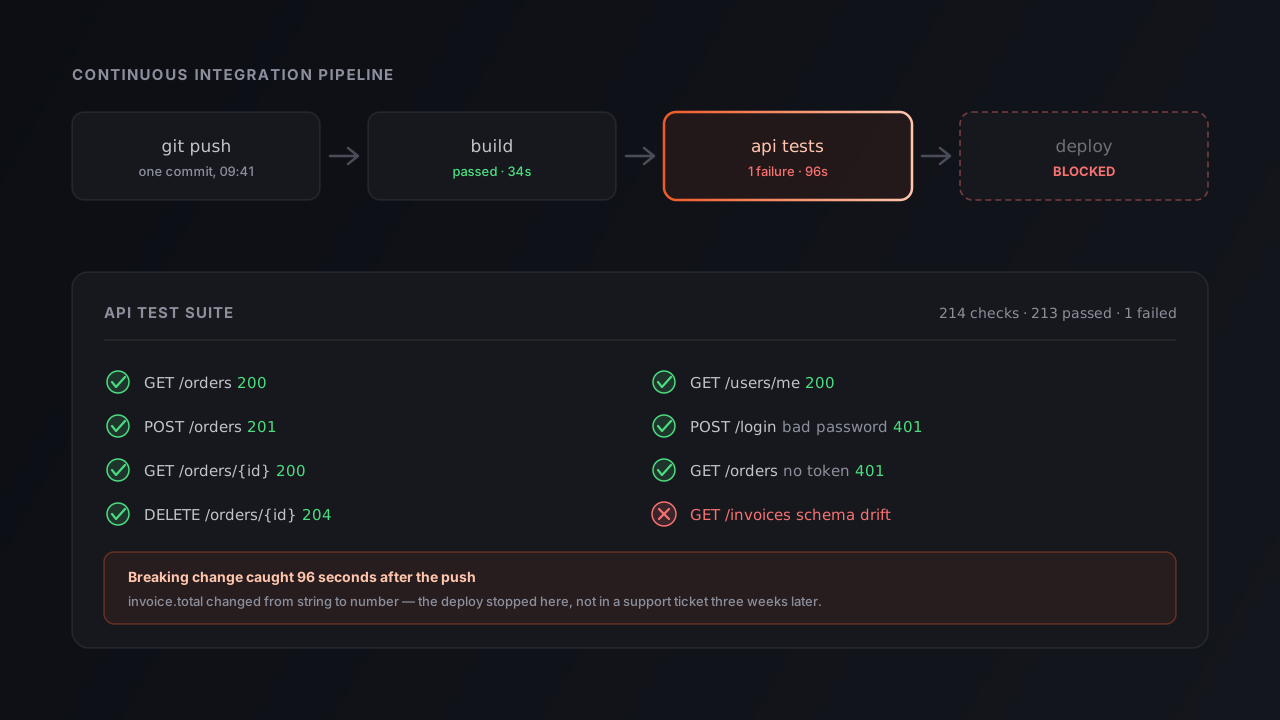
Native fit with CI/CD. Automated API suites plug directly into Jenkins, GitHub Actions, or GitLab CI, so a failing test blocks a bad deploy automatically instead of relying on someone remembering to check a dashboard.
Coverage a human would quietly skip. Malformed payloads, expired tokens, unusual character sets, missing required fields, wrong content types, concurrent requests to the same resource. Tedious to re-test by hand, trivial for a script to run on every commit. This is where most of the real value hides — the negative cases nobody has the patience to check manually twice.
Reusability across environments. A well-written suite doesn’t get rebuilt for staging versus production. The same tests move with the code; only the base URL and credentials change.
A record of what “working” means. This one gets underrated. A good API suite is executable documentation of your API’s actual contract — every status code it’s supposed to return, every field it’s supposed to include. New engineers read it to learn how the service behaves.
None of this eliminates the need for skilled testers. It moves their time away from repetitive clicking and toward the judgment calls automation can’t make: deciding what’s worth testing, designing the edge cases, investigating genuinely ambiguous failures, and thinking through what might break next.
What an Automated API Test Should Assert
Here’s the most common way an automated API suite ends up providing false comfort: every test asserts the status code and nothing else. The suite is green, the pipeline is fast, and a 200 OK full of wrong data sails straight through.
A test that only checks assert status == 200 is verifying that the server didn’t crash. That’s a low bar. Layer your assertions instead:
| Layer | What you’re checking | Example |
|---|---|---|
| Status | The right HTTP code, including on errors | POST /orders with a bad payload returns 400, not 500 |
| Schema | Field names, types, required fields | total is a number; email matches an email format; id is always present |
| Semantics | The business rule actually held | Order total equals the sum of line items plus tax |
| Headers | Content type, caching, security | Content-Type: application/json; Cache-Control set as intended |
| Authorization | The absence of access is enforced | User A’s token cannot read User B’s order — returns 403, not 200 |
| Performance | A latency ceiling on the critical path | GET /orders responds under 800ms at the 95th percentile |
| Idempotency | Repeating a call is safe where it should be | The same PUT twice leaves the resource identical |
Two of these deserve emphasis because they’re the ones most often missing.
Schema assertions are what catch the failure mode from the hero image above: a field silently changing type from string to number. No status code moves. No error is thrown. Every status-only test stays green, and a mobile client crashes on the next release. Generating a schema from a known-good response — the free JSON to Schema tool does this in one paste — and asserting against it turns an invisible break into a loud one. Our schema validation guide goes deeper on how this fits with OpenAPI.
Authorization assertions are the ones teams skip because they feel paranoid, right up until they aren’t. The test that matters isn’t “an authenticated user can read their order.” It’s “an authenticated user cannot read someone else’s order.” Broken object-level authorization is a persistent top-ranked API security risk precisely because the happy-path test always passes.
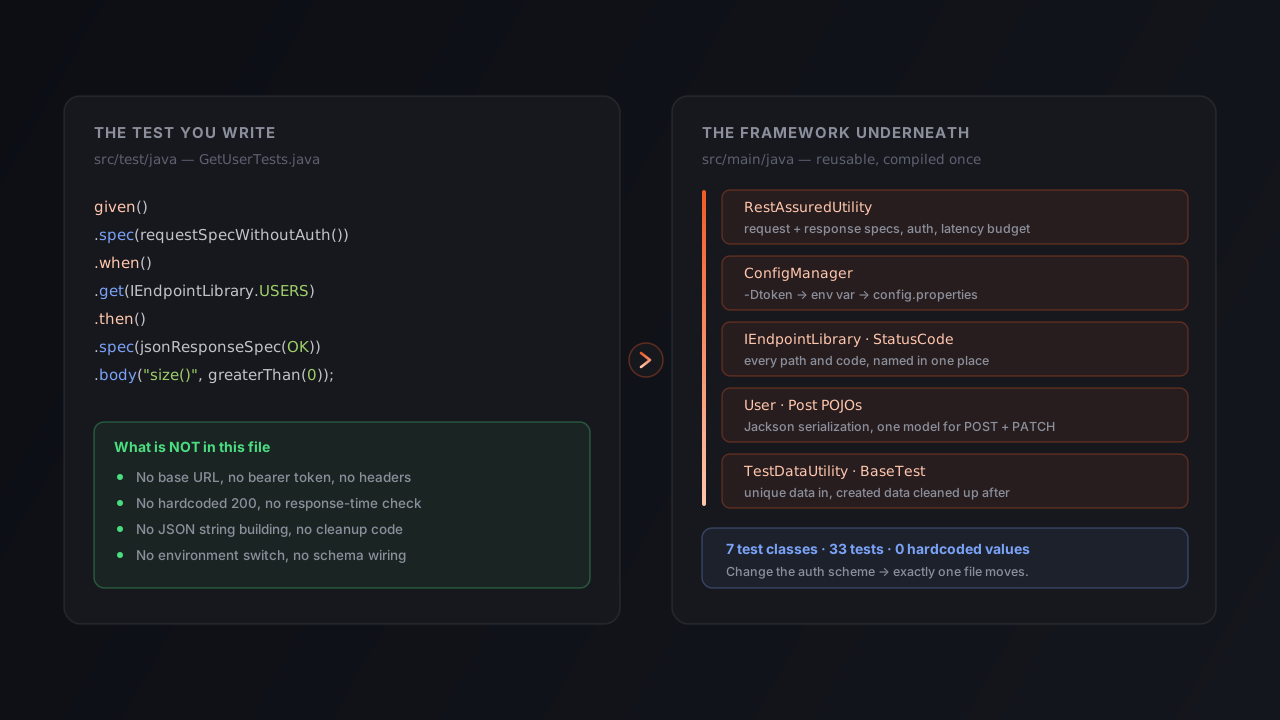
There’s a broader principle here, and it’s the thing that separates a suite that catches bugs from one that mostly catches typos: most of your value comes from tests you expect to fail. Wrong credentials, missing fields, expired tokens, out-of-range values. If your suite is 90% happy path, it’s mostly verifying that things work when everything goes right — which is exactly the scenario nobody needed reassurance about. I wrote up a full framework built around this idea in an API test framework where 16 tests fail on purpose.
The Toolbox: What Teams Actually Use
There’s no single correct tool. The right pick depends on your stack, your team’s comfort with code, and whether you need a GUI for exploration.
Postman + Postman CLI / Newman — the most common starting point. Friendly enough for manual exploration, scriptable enough to run headlessly in a pipeline. One current wrinkle worth knowing: Postman’s own guidance now points new work toward the Postman CLI rather than Newman. Newman isn’t deprecated and still ships maintenance releases, but it isn’t compatible with the collection v3 format used by Postman v12 and later, which is the only format supported in Postman’s Git workflows. If you’re standing up CI today, start with the Postman CLI; if you have a working Newman pipeline on older collections, it keeps working.
REST Assured — the default for Java-heavy teams who want tests written as real code rather than GUI configuration. Fluent given/when/then syntax, sits naturally alongside JUnit or TestNG, and gives you the full power of a real language for test data setup.
Karate — notable for genuinely collapsing tool sprawl. It’s a single MIT-licensed DSL covering REST, GraphQL, SOAP, browser automation, mock servers, and performance testing, and it lets you reuse the same .feature file as a Gatling load test without rewriting it. Tests are written in Gherkin, so they read close to plain English — appealing if non-engineers need to follow along, less appealing if your team would rather write Java.
ReadyAPI — aimed at larger organizations that need reporting, governance, and analytics out of the box rather than assembled from parts. SmartBear added AI test generation in May 2026, with the notable design choice that it can be disabled entirely — a real requirement for regulated industries where AI-generated artifacts create compliance questions.
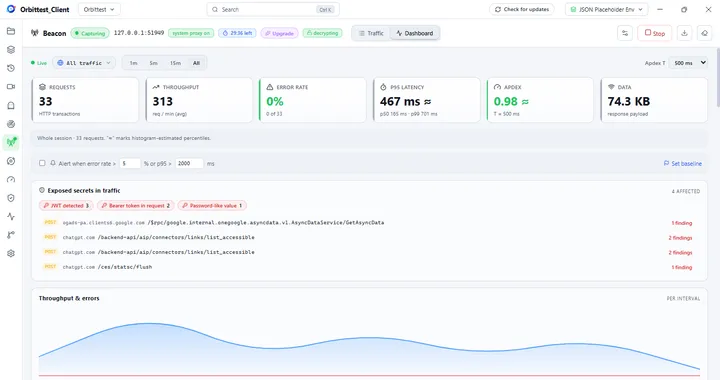
Local-first desktop clients — a smaller but growing category for teams who can’t or won’t send request data, tokens, and internal endpoints to a vendor cloud. Orbittest Client sits here: collections and environments, OAuth 2.0 and bearer auth, data-driven runs over CSV/JSON, scheduled monitors, and contract testing for schema drift, all running on your machine with no account.
Most teams end up with two or three of these rather than standardizing on one — often a GUI client for exploration and debugging, plus a code-based framework for the suite that actually runs in CI.
Wiring It Into CI/CD
A test suite that someone has to remember to run is not automation. The whole value proposition depends on the suite running without anyone deciding to run it, and on a failure actually stopping something.
A minimal GitHub Actions setup looks like this:
name: API Tests

on:
  push:
    branches: [main]
  pull_request:

jobs:
  api-tests:
    runs-on: ubuntu-latest
    steps:
      - uses: actions/checkout@v4

      - name: Run API suite
        uses: postmanlabs/postman-cli-action@v1
        with:
          command: >-
            collection run tests/orders.json
            --environment tests/ci.json
            --reporters cli,junit
        env:
          API_BASE_URL: ${{ secrets.STAGING_API_URL }}
          API_TOKEN: ${{ secrets.STAGING_API_TOKEN }}

      - name: Upload results
        if: always()
        uses: actions/upload-artifact@v4
        with:
          name: api-test-report
          path: testResults/
Three details in there matter more than the rest:
Credentials come from secrets, never the repository. Test tokens committed to a collection file are a genuine breach vector, and they’re depressingly common. Environment files in version control should contain variable names, not values — the actual secrets get injected at runtime, as above.
if: always() on the artifact upload. Without it, the report is only uploaded when tests pass — which is precisely backwards, since the run you most need to inspect is the one that failed.
A non-zero exit code has to fail the job. Most runners do this by default, but it’s worth verifying deliberately, because a suite that reports failures while the pipeline stays green is worse than no suite at all: it manufactures confidence it hasn’t earned.
Beyond the wiring, think about tiering the suite by speed. A practical split:
- On every commit: a smoke subset covering critical paths. Target under two minutes.
- On every pull request: the full functional suite, including negative and authorization cases.
- On a schedule (nightly or hourly against production): contract checks, performance thresholds, and long-running data-driven runs.
If the on-commit suite grows past a few minutes, developers start finding ways around it. Protecting that budget is a real engineering constraint, not a nice-to-have.
Automation Is Not Set-and-Forget
It’s worth being honest about the friction, because pretending automation is maintenance-free is how teams get blindsided six months in.
APIs change. Fields get renamed, tokens expire, new required parameters appear, response shapes shift. Every one of those can break a test — not because the API is broken, but because the test was written against a version of reality that no longer exists.
And a surprising share of “failed test” alerts turn out to be stale test data, not real defects. Hardcoded record IDs that got deleted. Credentials that expired. Seed data wiped when staging was refreshed. A test asserting a user has exactly 3 orders, which passed until someone placed a fourth.
This matters more than it sounds, because the real cost isn’t the debugging time. It’s what psychologists call alarm fatigue and engineers call “oh, that test always fails.” Once a suite cries wolf often enough, people start ignoring red builds — and at that point the suite provides zero protection while still consuming CI minutes and engineering attention. A suite nobody trusts is worse than no suite, because it looks like coverage.
The fix isn’t more tests. It’s more disciplined ones:
- Create your own test data, then clean it up. A test that creates an order, asserts on it, and deletes it is immune to whatever else is in the database. A test that assumes order #4471 exists is one staging refresh away from failing forever.
- Fetch credentials at runtime, never hardcode them. Get a fresh token in a setup step. Storing one in a collection guarantees a mystery failure the week it expires.
- Assert on shape and rules, not exact values that legitimately change.
orders.length > 0and “every order has a valid status” survive a data refresh.orders.length == 3does not. - Make tests independent and order-agnostic. If test B only passes because test A ran first, your suite can’t run in parallel and one unrelated failure cascades into ten.
- Delete tests that no longer earn their runtime. Suites accumulate. A test covering a removed feature isn’t neutral — it’s a future false failure with a maintenance bill attached.
- Treat a false failure as a bug in the test. Don’t rerun until green. Fix the test so it can’t fail that way again, or the same alert arrives next week.
Microservices Changed the Question
Distributed architecture quietly redefined what “testing an API” means. A single user action — placing an order — might trigger a chain of a dozen internal calls: auth, inventory, pricing, payment, notification, analytics. Each service is independently deployed by a different team on a different schedule.
The naive response is to write end-to-end tests spanning the whole chain. This works for a handful of critical journeys and becomes miserable beyond that: the tests are slow, they need every service running simultaneously, and when one fails you get “order creation failed” without knowing which of twelve services caused it.
The approach that scales is contract testing. Instead of testing services together, each pair agrees on a contract — what the consumer expects, what the provider promises — and each side verifies its half independently against that contract. The payments team can deploy at 2pm without waiting for a shared integration environment, because their build already proved they didn’t break what the orders service expects.
The practical payoff is a change in when you find out. Without contracts, a provider renames a field, deploys, and the consumer breaks in production. With contracts, the provider’s own build fails before merge, with a message naming the field and the consumer that depends on it. Same bug, discovered by the person who caused it, before it shipped. Our contract testing guide covers how to actually set this up.
Where AI Genuinely Helps (And Where It Doesn’t)
This is the section most articles get wrong, so it’s worth separating the genuinely useful from the oversold.
Self-healing tests are real, but they solve a UI problem. The mechanism is mature and widely shipped in 2026: when a button moves or a CSS class is renamed, the tool infers which element was intended and repairs the broken locator. That’s a genuine time saver — UI locator churn eats a large share of QA maintenance time in browser suites.
But that mechanism does not transfer cleanly to API tests, and it’s worth understanding why. Self-healing works on UI locators because a moved button is unambiguously not a behavior change — the test’s intent is unchanged, only the address of the element moved. API tests don’t break that way. They break because a contract changed, a field was renamed, a status code changed, or business logic shifted. Those are exactly the changes a test is supposed to fail on. An API test that “healed” itself by accepting a renamed field would be silently deleting the coverage you built it for.
So be skeptical of “self-healing API testing” as a headline feature. Ask what it actually repairs. If the answer is “it updates assertions to match the new response,” that’s not healing — that’s a rubber stamp.
What does genuinely help on the API side:
- Test generation from a spec. Point a tool at an OpenAPI definition and get scaffolding for every endpoint, including negative cases for each required field and type constraint. This is real leverage — the tedious first 70% of a suite, generated in minutes. ReadyAPI’s 2026 AI test generation and similar features across the ecosystem target exactly this.
- Contract drift detection. Not AI at all, just diffing — but far more valuable than any healing feature. Compare today’s response schema against the recorded baseline and report exactly what changed. This gives you the opposite of self-healing: instead of quietly adapting, it fails loudly with a precise diff.
- Failure triage. Clustering a hundred red tests into “these 94 are one auth token expiry, these 6 are separate” saves real time during an incident.
The honest summary: AI has meaningfully reduced the cost of writing API tests, and has barely touched the cost of deciding what to test. Generated tests still need someone to check that they assert anything meaningful — a generated test that only confirms 200 OK is fast to produce and nearly worthless to keep.
A Realistic Starting Plan
If you’re starting from zero, resist the urge to aim for full coverage. Suites that try to cover everything on day one usually collapse under their own maintenance weight before they prove any value. A sequence that tends to work:
- Pick your five highest-risk endpoints. Not the easiest — the ones where a silent failure costs the most. Login, checkout, payment status.
- Write the happy path plus three failure cases for each. Missing required field, invalid auth, and a boundary value. Twenty tests total.
- Assert schema, not just status. Do this from the first test, not as a later cleanup. Retrofitting assertions across a hundred tests is a project; including them from the start is free.
- Wire it into CI and make it block merges. This is the step that converts a script into a safety net. A suite that doesn’t gate anything is a hobby.
- Only then expand coverage — and only for endpoints where a failure would actually matter.
Twenty well-maintained tests that block bad merges beat four hundred that everyone ignores. That’s not a compromise position; it’s the outcome most teams that succeed at this actually arrive at.
Frequently Asked Questions
What is API testing automation?
It’s the use of scripts or dedicated tools to automatically send requests to an API and verify the response — status code, body and schema, headers, business rules, and response time — without a human sending each request by hand. It typically runs in a CI/CD pipeline on every push, so a broken endpoint surfaces in minutes rather than weeks.
Is API testing automation only worth it for large companies?
No. The threshold isn’t company size, it’s release frequency and endpoint count. A two-person team deploying daily gets more from it than a fifty-person team shipping quarterly. Once you deploy more often than you can realistically re-check every endpoint by hand, automation stops being optional.
Does automated API testing replace QA engineers?
No. It replaces the repetitive execution of known checks, not the judgment behind them. Someone still decides what’s worth testing, designs the negative and boundary cases, investigates ambiguous failures, and explores what nobody thought to script.
What should an automated API test actually assert?
At minimum: status code, response schema, the specific business values that matter, and a response-time ceiling. Asserting only the status code is the most common weak spot — a 200 OK can contain completely wrong data, and a status-only test will happily pass.
What is the biggest challenge with API test automation?
Maintenance, specifically false failures. Hardcoded IDs, expired credentials, and wiped seed data produce failures unrelated to any real defect. Once a suite cries wolf often enough, red builds get ignored — and then it provides no protection while still costing time.
How is API test automation different from UI test automation?
API tests talk directly to the service over HTTP: much faster, far more stable, and they name the failing endpoint. UI tests verify what the user actually sees end to end. Most teams run many more API tests than UI tests, reserving browser automation for a few critical journeys.
Can AI automatically fix broken API tests?
Partly, and less than the marketing suggests. Self-healing is mature for UI tests, where it repairs element locators after a layout change. That doesn’t transfer cleanly to APIs, which break on changed contracts and logic — exactly what a test should fail on. What genuinely helps is AI-assisted generation from an OpenAPI spec, plus contract testing that reports precisely what changed.
How many API tests should run on every commit?
Enough to finish in a few minutes. A common split: a fast smoke subset on every commit, the full functional suite on every pull request, and slower contract and performance checks on a schedule. If the on-commit suite outlasts a coffee break, developers start routing around it.
Key Takeaways
- A broken API often renders as a perfectly normal-looking screen — which is why UI testing alone leaves real gaps.
- API tests hit the sweet spot: fast and stable enough for every commit, real enough to catch integration bugs.
- Status-code-only assertions are the most common source of false confidence. Assert schema, semantics, authorization, and latency too.
- Choose tools by stack, not hype — and note that Postman now points new CI work at the Postman CLI rather than Newman for v12+ collections.
- The suite has to gate something. Automation that doesn’t block a bad merge is a script, not a safety net.
- False failures are the real killer. A suite nobody trusts is worse than none, because it looks like coverage.
- Self-healing is a UI capability. On the API side, the equivalent value comes from contract drift detection that fails loudly, not quietly.
- Twenty well-maintained tests that block merges beat four hundred that everyone ignores.
The Bottom Line
Manual, click-by-click API checking made sense when software shipped once a quarter. It doesn’t when it ships every day.
But the goal was never “more tests.” It’s a shorter distance between introducing a defect and finding out about it. Every practice in this guide — schema assertions, CI gating, contract testing, disciplined test data — is a different way of compressing that distance from three weeks to ninety seconds.
Teams that get this right don’t just ship faster. They spend dramatically less time firefighting production issues, because the issues stopped at a pipeline stage where fixing them was cheap and nobody was watching.
Start with your five riskiest endpoints. Assert more than the status code. Make it block the merge.
Next, see how contract testing catches the breaking changes that slip past ordinary assertions in contract testing explained, or go deeper on the schema layer in schema validation explained.
Written by Abhay Kumar — QA engineer and creator of OrbitTest, building practical tools for browser, mobile, and API testing. Browse more API testing articles.