Schema validation is the process of checking that a piece of data — usually JSON — matches a predefined structure before your application trusts it. The structure, called a schema, spells out which fields must exist, what type each one is, which values are allowed, and what counts as invalid. Validate on the way in and you reject bad data before it corrupts a database; validate on the way out and you catch a backend team’s “harmless” refactor before it crashes a mobile app that shipped two years ago.
That’s the short version. Here’s what it actually looks like in a production API, why “it passed my tests” doesn’t mean “it’s valid,” and which tools are worth bookmarking.
What Is Schema Validation, Exactly?
A schema is a contract written in a machine-readable format. For JSON APIs, that format is almost always JSON Schema, now standardized at draft 2020-12. A validator takes two inputs — the schema and the actual data — and returns one of two answers: valid, or a list of exactly what’s wrong and where.
{
  "type": "object",
  "required": ["id", "email", "plan"],
  "properties": {
    "id": { "type": "integer" },
    "email": { "type": "string", "format": "email" },
    "plan": { "type": "string", "enum": ["free", "pro", "enterprise"] },
    "trial_ends_at": { "type": ["string", "null"], "format": "date-time" }
  },
  "additionalProperties": false
}
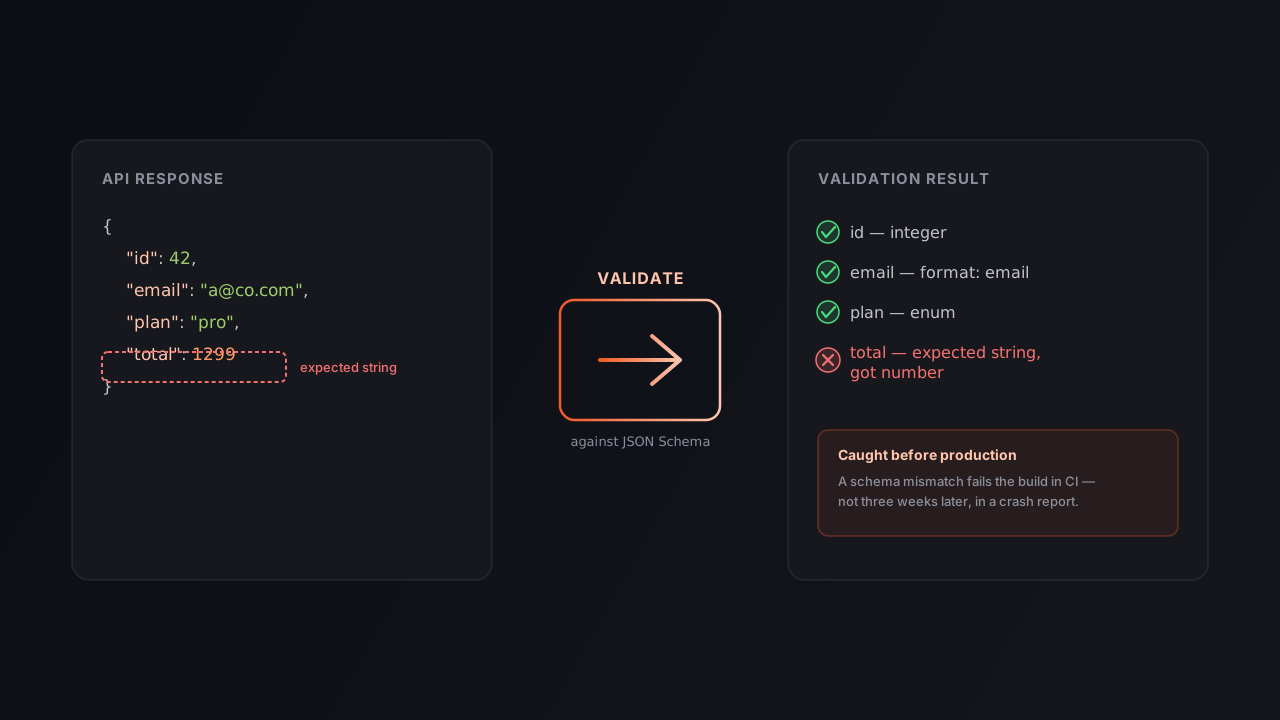
Feed that schema a payload missing email, or one where plan is "premium" instead of an allowed value, and validation fails immediately — with a precise reason, not a downstream stack trace three services later.
Why Schema Validation Matters More Than It Looks Like It Should
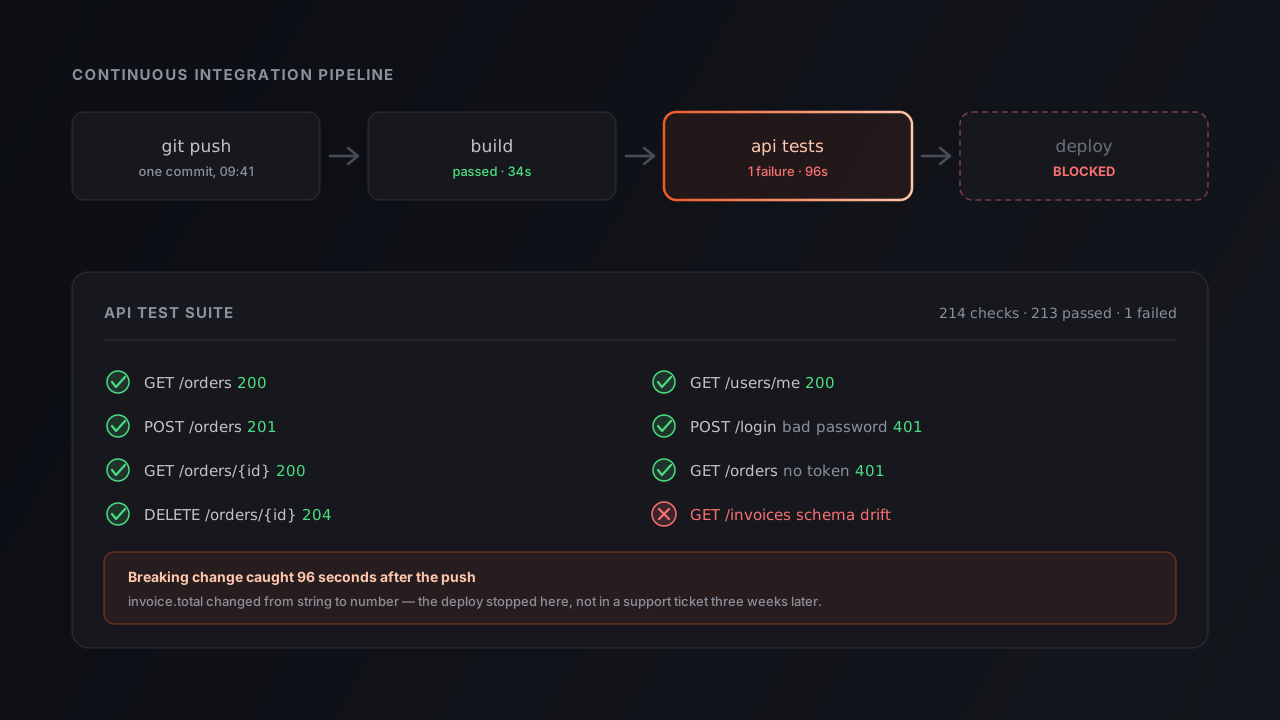
Here’s the failure that makes this concrete. A backend team “cleans up” an endpoint: a total field that used to serialize as the string "1299.00" now serializes as the number 1299. Nothing about the change looks risky — it compiles, the unit tests pass, the API still returns a 200. Three weeks later, a mobile app released two years earlier — one that calls .replace(",", "") on total because it always arrived as a string — crashes for every user on that build. Nobody touched the mobile app. Nobody ran its tests. The contract just moved out from under it.
A schema sitting between the two sides would have caught this in CI, in milliseconds, with a diff that says exactly what changed: total: string → number. That’s the entire value proposition of schema validation — it turns “we think this response looks right” into “the machine confirms this response matches what we promised,” and it does it before a human ever has to notice something’s off in production. This is also the exact failure mode contract testing exists to prevent — schema validation is the mechanism underneath it.
JSON Schema: The Standard Behind Most Validation
JSON Schema splits into two parts: Core, which defines how schemas reference and compose each other, and Validation, which defines the actual assertion keywords — type, required, minimum, pattern, enum, and so on. The current draft, 2020-12, replaced the old items/additionalItems pair with prefixItems and items, and added $dynamicRef for schemas that need to extend each other recursively. Unless you have a specific legacy reason not to, target 2020-12 — it’s what current tooling, including OpenAPI 3.1 and 3.2, is built around.
The keywords you’ll use constantly:
type— string, number, integer, boolean, object, array, or null.required— an array of property names that must be present.enum— a closed list of acceptable values.pattern— a regular expression a string must match (useful for phone numbers, SKUs, slugs).additionalProperties: false— rejects any field not explicitly declared. This one catches more real bugs than any other keyword on this list, because it’s the only thing standing between “the API added an undocumented field” and nobody noticing.minimum/maximum/minLength/maxLength— the boundary constraints that make schema validation and boundary value analysis natural partners: the schema defines the legal range, and BVA tells you exactly which values at the edge of that range to test.
How Schema Validation Actually Runs, Step by Step
- Define the schema once, ideally generated from a real payload rather than typed by hand — typing it by hand is how
additionalPropertiesgets forgotten. Paste a sample response into a JSON-to-Schema generator and it infers types, required fields, and formats automatically. - Compile it. Most validators compile a schema into a fast validation function once, then reuse it per request — compiling on every call is the most common performance mistake in schema validation code.
- Validate the instance. The validator walks the data against every keyword in the schema and collects failures rather than stopping at the first one, so you get the complete list of what’s wrong in one pass.
- Act on the result. For incoming data, reject the request with a 400 and the validator’s error list. For outgoing data, either fail the build (in CI, via contract tests) or, in production, log and alert — you generally don’t want to 500 a real user because your own team’s response drifted.
Schema Validation Inside API Testing
This is where schema validation stops being a backend implementation detail and becomes a QA responsibility. A response can return 200 OK with a body that is structurally wrong — a field silently renamed, a type quietly changed, a previously-required field now optional — and a naive test suite that only checks the status code and a couple of hardcoded values will never catch it.
The fix is to validate the shape of every response against a schema, on every run, not just the values you happened to assert on:
const Ajv = require("ajv");
const ajv = new Ajv();
const validate = ajv.compile(userSchema);

const response = await fetch("/api/users/1").then(r => r.json());

if (!validate(response)) {
  throw new Error(JSON.stringify(validate.errors, null, 2));
}
Do this once per endpoint and you’ve built a lightweight contract test. Do it against a saved baseline schema and diff the two, and you’ve built drift detection — which is exactly what catches the total: string → number bug before it ships, instead of three weeks after. If comparing two raw responses is easier than maintaining schemas by hand, a JSON diff tool will surface the same kind of change at a glance.
OpenAPI and Schema Validation Are the Same Conversation Now
If your team documents APIs with OpenAPI, you’re already halfway to full schema validation. OpenAPI 3.1 aligned its schema objects directly with JSON Schema draft 2020-12, and OpenAPI 3.2 — released in late 2025 — kept that alignment while adding structured tags and clearer streaming semantics on top. Practically, this means the schema block under any requestBody or response in your OpenAPI spec is a valid JSON Schema document. You don’t need a separate validation layer maintained by hand; you can extract the schema straight from the spec you’re already writing and validate live traffic against it.
Schema Validation Tools Worth Knowing
| Tool / Library | Language | Best for |
|---|---|---|
| AJV | JavaScript/TypeScript | Fastest JSON Schema validator; the default choice for Node.js APIs |
| Zod | TypeScript | Schema definition and static types from one source, popular in newer TS codebases |
| Joi | JavaScript | Readable, chainable validation syntax; common in Express APIs |
| Pydantic | Python | Type-hint-driven validation; the default in FastAPI |
| jsonschema | Python | Straightforward draft 2020-12 validation without a framework |
| Contract Drift Radar (Orbittest Client) | No code | Compares live API responses against a saved baseline and flags added, removed, or changed fields automatically |
If you want validation without writing or maintaining schema code at all, Orbittest Client’s Contract Drift Radar does the comparison for you locally, and its Ghost Mock Server can replay a known-good schema as a mock so front-end work doesn’t stall while a drifting backend gets fixed.
Common Schema Validation Mistakes
- Leaving
additionalPropertiesunset. By default, JSON Schema allows extra fields. That’s usually the opposite of what you want — undocumented fields are exactly what silently breaks old clients. - Validating only requests, never responses. Input validation protects your database; it does nothing for the client relying on your output shape.
- Confusing “optional” with “nullable.” A field that’s missing and a field that’s present but
nullare different states in JSON Schema, and treating them the same hides real bugs. - Writing schemas once and never updating them. A schema that isn’t regenerated when the API changes becomes actively misleading — worse than no schema, because it creates false confidence.
- Skipping schema validation in CI. Manual, occasional checks catch nothing. Wire it into every pipeline run the same way you’d wire in a unit test.
Frequently asked questions
What is schema validation used for?
Schema validation checks that data — most often a JSON API request or response — matches an agreed structure before it’s trusted, stored, or displayed. It’s used to reject malformed input, catch backend changes that would break existing clients, and generate accurate documentation and types from a single source of truth.
What’s the difference between schema validation and data validation?
Data validation is the broader idea — any check that data is correct, including business rules like “the discount can’t exceed 100%.” Schema validation is a specific, structural subset: type, required fields, formats, and allowed values, expressed in a standard format like JSON Schema so tools can enforce it automatically.
Is JSON Schema the same as OpenAPI?
No, but they’re closely related. JSON Schema validates the shape of JSON data in general. OpenAPI describes an entire API — endpoints, methods, parameters — and since version 3.1, uses JSON Schema (draft 2020-12) directly for its schema objects.
How do I generate a JSON Schema without writing it by hand?
Paste a real sample response into a JSON-to-Schema generator, which infers types, required fields, and formats automatically. It’s faster and less error-prone than hand-authoring, especially for nested or array-heavy payloads.
Conclusion
Schema validation is the difference between “the API returned 200” and “the API returned exactly what it promised.” It costs almost nothing to add — a generated schema and a few lines of validator code — and it catches the one class of bug that hardcoded assertions and manual QA consistently miss: the structural change that nobody flagged as risky because it wasn’t wrong, just different. Wire it into request handling, wire it into CI, and the total: string → number story stops being an incident and starts being a diff you review in code review.
Written by Abhay Kumar — QA engineer and creator of OrbitTest, writing about API testing, automation, and web security. Browse more API testing guides.