APIs are the backbone of modern software. Your frontend talks to a backend API, mobile apps consume APIs, microservices communicate through APIs, and third-party integrations depend on them. Which raises an uncomfortable question: what happens when one team changes an API response without telling everyone else?
A frontend crashes. A mobile app shows blank screens. An integration partner receives data it can’t parse. A deployment that looked perfectly green becomes a production incident. The frustrating part is that every individual test passed — the endpoint returned 200 OK, unit tests were green, the build shipped. The shape of the data changed, and nothing caught it.
This is exactly the gap that contract testing fills. In this guide you’ll learn what it is, why functional tests aren’t enough, how consumer-driven contracts work, and how to put a practical contract-testing workflow in place.
Table of Contents
- What Is Contract Testing?
- Why Traditional API Testing Is Not Enough
- What Problems Does Contract Testing Solve?
- Contract Testing vs Integration Testing
- Consumer-Driven Contract Testing
- Common API Contract Breakages
- Contract Testing in Microservices
- A Real-World Example
- How to Do Contract Testing with Orbittest Client
- A Practical Contract Testing Workflow
- Best Practices
- Common Mistakes
- Benefits of Contract Testing
- Frequently Asked Questions
- Conclusion
What Is Contract Testing?
A contract is simply an agreement between two systems. For APIs, that contract defines the shape of the conversation:
- Request structure
- Response structure
- Required vs optional fields
- Data types
- Status codes
- Headers
- Authentication requirements
Take this response:
{
  "id": 101,
  "name": "John Doe",
  "email": "john@example.com"
}
The frontend that consumes it expects id to be a number, name to be a string, and email to be present. That set of expectations is the contract. Contract testing verifies that the provider keeps honoring it — release after release. The idea is well-described in Martin Fowler’s writing on contract tests.
Why Traditional API Testing Is Not Enough
Most teams lean on functional tests. Send a request, check the status:
GET /users/101Status = 200 ✅ test passesNow imagine the response quietly changes. Before:
{ "id": 101, "name": "John Doe" }After:
{ "id": "101", "fullName": "John Doe" }The API still returns 200. The functional test still passes. And production still breaks, because id flipped from a number to a string and name was renamed to fullName. The status code never told the truth — only the schema did. (If you’re shaky on what each code actually guarantees, our guide to HTTP status codes is a good companion read.)
Contract testing catches this because it validates the structure of the response, not just the fact that one came back.
What Problems Does Contract Testing Solve?
Contract testing is built to detect the changes that slip past functional tests:
- Missing fields
- Renamed fields
- Type mismatches (number → string)
- Response structure changes (flattened or nested differently)
- Authentication contract changes
- Header changes
- Version compatibility issues
The difference in outcome is stark:
| Without contract testing | With contract testing |
|---|---|
| Backend deploys a change | Backend deploys a change |
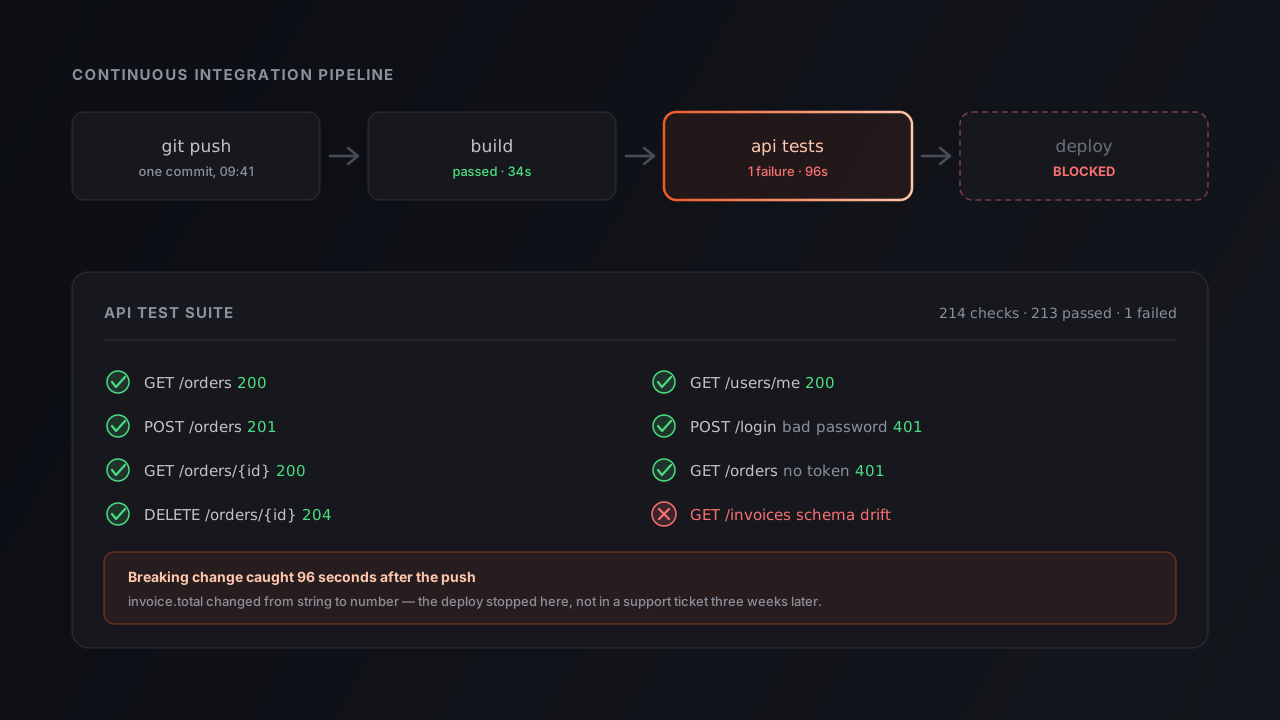
| Frontend breaks in production | Contract validation fails in CI |
| Users hit the incident first | Deployment is blocked |
| Hotfix under pressure | Issue fixed before release |
Contract Testing vs Integration Testing
These two get confused constantly, but they answer different questions.
Integration testing asks: can Service A talk to Service B? It verifies connectivity — a request goes out, a response comes back, the status is 200.
Contract testing asks: is the response exactly what the consumer expects? It verifies compatibility — the right fields, the right types, the right structure.
| Integration Testing | Contract Testing | |
|---|---|---|
| Question | Can they communicate? | Is the data shape correct? |
| Catches | Network/connectivity failures | Field/type/structure changes |
| Passes when | A response is received | The schema matches the agreement |
Integration tests verify connectivity. Contract tests verify compatibility. You need both.
Consumer-Driven Contract Testing
In traditional API development, the provider defines the API and every consumer adapts. Consumer-driven contract testing flips that: the consumers declare what they expect, and the provider must keep satisfying those expectations (or evolve them compatibly).
If the frontend declares it needs:
{ "id": 1, "name": "John" }then the backend must keep returning that shape — or only make additive, backward-compatible changes. This model shines in microservices, enterprise systems, SaaS platforms, and mobile apps, where one provider serves many consumers. It was popularized by Martin Fowler’s article on consumer-driven contracts, and tools like Pact are built around it.
Common API Contract Breakages
Most production-breaking changes fall into a handful of patterns. Each of these is a breaking change:
1. Field removal — a consumer still reads it:
{ "email": "user@test.com" } → { }2. Field rename — same data, new key:
{ "userName": "John" } → { "name": "John" }3. Type change — number becomes string:
{ "id": 123 } → { "id": "123" }4. Nested structure change — flattening or re-nesting:
{ "address": { "city": "London" } } → { "city": "London" }5. Authentication change — the auth mechanism shifts:
Authorization: Bearer <token> → X-API-Key: <token>A reliable way to spot these is to diff the new response against a known-good baseline — a JSON diff tool makes the change obvious instantly, and a JSON-to-schema generator turns a trusted response into a contract you can validate against. For the auth-specific cases, see our API authentication guide.
Contract Testing in Microservices
Microservices multiply the risk. Picture a system with a User Service, Order Service, Payment Service, Notification Service, and Analytics Service. One small change to a shared response can ripple outward:
One deployment → five services breakWith contract testing in the pipeline, the same change is caught before it spreads:
One deployment → contract validation fails → release blockedThe more distributed your architecture (see Fowler on microservices), the more contract testing pays for itself.
A Real-World Example
Suppose a mobile app consumes:
{ "userId": 123, "name": "Abhay", "subscription": "Premium" }and reads response.subscription to decide what to show. A backend developer renames the field:
{ "userId": 123, "name": "Abhay", "plan": "Premium" }Everything compiles. Unit tests pass. The endpoint returns 200. But the mobile app crashes, because subscription is now undefined. Contract testing would have flagged this immediately:
Removed field: subscription
Added field:   plan
…before a single user ever hit the bug.
How to Do Contract Testing with Orbittest Client
Orbittest Client is built for teams that want visibility into API behavior and schema changes — not just a way to fire requests. A few capabilities make it a practical contract-testing tool.
Contract Drift Radar
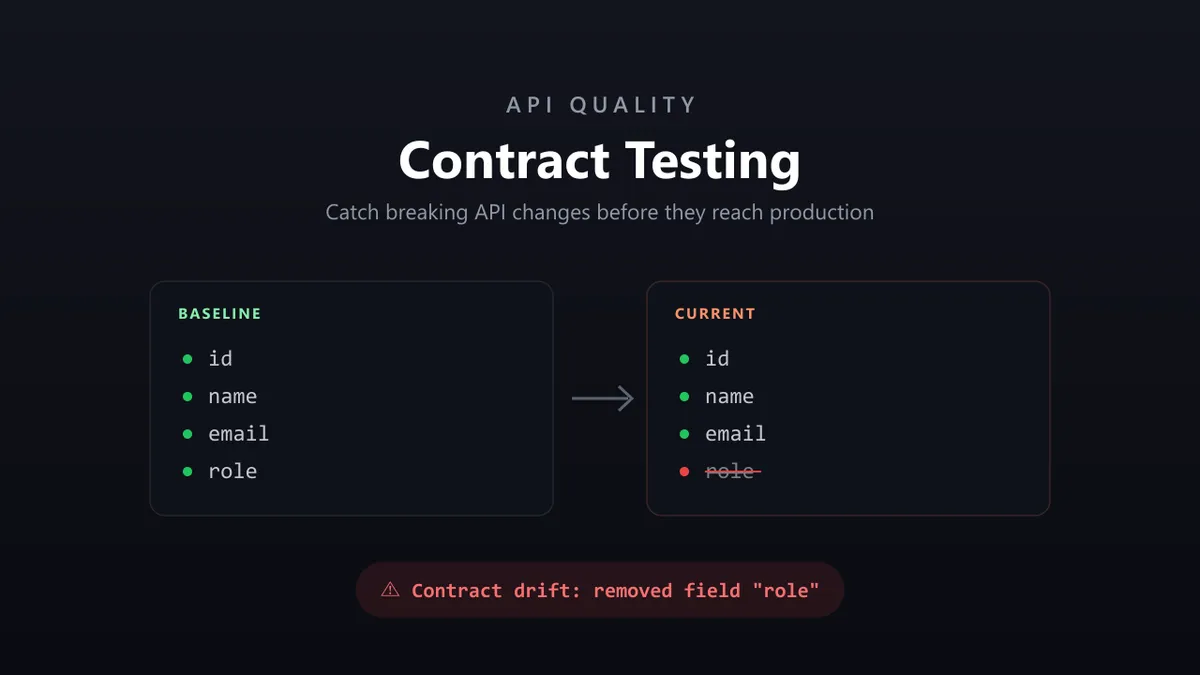
The hardest part of contract testing is detecting silent schema changes. Contract Drift Radar compares the current response schema against previous successful responses and highlights added, removed, modified, and structurally changed fields:
Baseline: name, email, role
Current:  name, email
→ Drift detected — removed field: role
That alert surfaces breaking changes before consumers ever discover them in production.
Automated Response Validation
Post-run validation scripts let you assert the contract directly, acting as lightweight contract tests on every run:
ot.test("email exists", () => {
  ot.expect(ot.response.json.email).toBeDefined();
});

ot.test("id is numeric", () => {
  ot.expect(typeof ot.response.json.id).toBe("number");
});
Data-Driven Contract Verification
APIs often return different shapes for different inputs. Orbittest Client supports data-driven execution with CSV and JSON datasets, so you can confirm the contract holds across many scenarios, not just the happy path.
Ghost Mock Server
When a backend isn’t available, Ghost Mock Server can replay recorded responses as a local endpoint — so consumers can keep developing and validating against a known contract. The user guide walks through setting these pieces up together.
A Practical Contract Testing Workflow
A repeatable flow that fits most teams:
- Create requests for your critical endpoints.
- Capture baseline responses you know are correct.
- Save validation scripts that assert required fields and types.
- Monitor Contract Drift Radar for schema changes.
- Run the collection before each deployment.
- Review detected schema changes.
- Approve or reject the API change based on the diff.
Wire steps 5–6 into CI/CD and contract validation stops being a manual afterthought.
Best Practices
- Version your APIs deliberately. Make breaking changes in a new version (
/v2/users) instead of mutating/v1/usersunderneath consumers. Follow semantic versioning so the version number signals intent. - Never remove fields abruptly. Deprecate first, remove later. Keep the old field (even as
null) while consumers migrate. - Validate on every deployment. Contract checks belong in CI/CD, staging, and release candidates — not just on someone’s laptop.
- Track schema drift continuously. Watch added, removed, and retyped fields over time.
- Maintain backward compatibility. Add new fields alongside existing ones rather than replacing them.
- Describe the contract formally. An OpenAPI definition or a JSON Schema gives you a machine-checkable source of truth.
Common Mistakes
- Relying on status codes alone. A
200says nothing about the response shape. - Renaming fields “for clarity” without versioning — the #1 cause of silent breakage.
- Changing types quietly (number → string) because a language coerced it anyway.
- Skipping contract checks for “small” changes. Small changes cause most incidents.
- Testing only the happy path, missing the conditional fields that vary by input.
Benefits of Contract Testing
Teams that adopt contract testing typically see:
- Fewer production defects
- Faster, more confident releases
- Better collaboration between provider and consumer teams
- Reduced integration failures
- Easier API version management
Most importantly: developers discover breaking changes during development, instead of after customers do.
Frequently Asked Questions
What is contract testing in simple terms?
It’s a way of verifying that an API keeps returning the structure its consumers expect — the right fields, types, and shape — so a change on the provider side doesn’t silently break the apps that depend on it.
How is contract testing different from integration testing?
Integration testing checks whether two services can communicate (connectivity). Contract testing checks whether the response matches the agreed structure (compatibility). They solve different problems, and most teams need both.
What is consumer-driven contract testing?
A model where consumers define what they expect from an API, and the provider must keep meeting those expectations. It’s especially valuable in microservices where one provider serves many consumers.
Does a 200 OK mean my API didn’t break?
No. A 200 only means the request succeeded at the HTTP level. The response body can still have removed fields, renamed keys, or changed types — all of which break consumers while the status stays green.
What counts as a breaking API change?
Removing a field, renaming a field, changing a field’s type, re-nesting or flattening structure, and changing authentication requirements are all breaking changes. Adding a new optional field is usually safe.
How do I detect schema drift automatically?
Capture a baseline response and compare each new response’s schema against it. Tools like Orbittest Client’s Contract Drift Radar do this automatically and flag added, removed, and modified fields; a JSON diff tool works for quick manual checks.
Where should contract tests run?
Ideally in your CI/CD pipeline so every deployment is validated, plus staging and release-candidate environments. Manual runs help during development but shouldn’t be the only safety net.
Conclusion
Modern software depends on APIs, and as systems become more distributed, the risk of breaking consumers with a seemingly tiny change keeps growing. Contract testing is the safety net: it keeps providers and consumers aligned and surfaces incompatible changes during development and deployment instead of in a production incident.
With capabilities like Contract Drift Radar, automated validation scripts, data-driven testing, and Ghost Mock Server, Orbittest Client helps teams catch contract violations early and keep their integrations reliable. If your APIs are shared across web apps, mobile apps, microservices, or third-party integrations, contract testing belongs in your API quality strategy.
Written by Abhay Kumar — QA engineer and creator of OrbitTest, writing about API testing, automation, and web security. Browse more API testing guides.