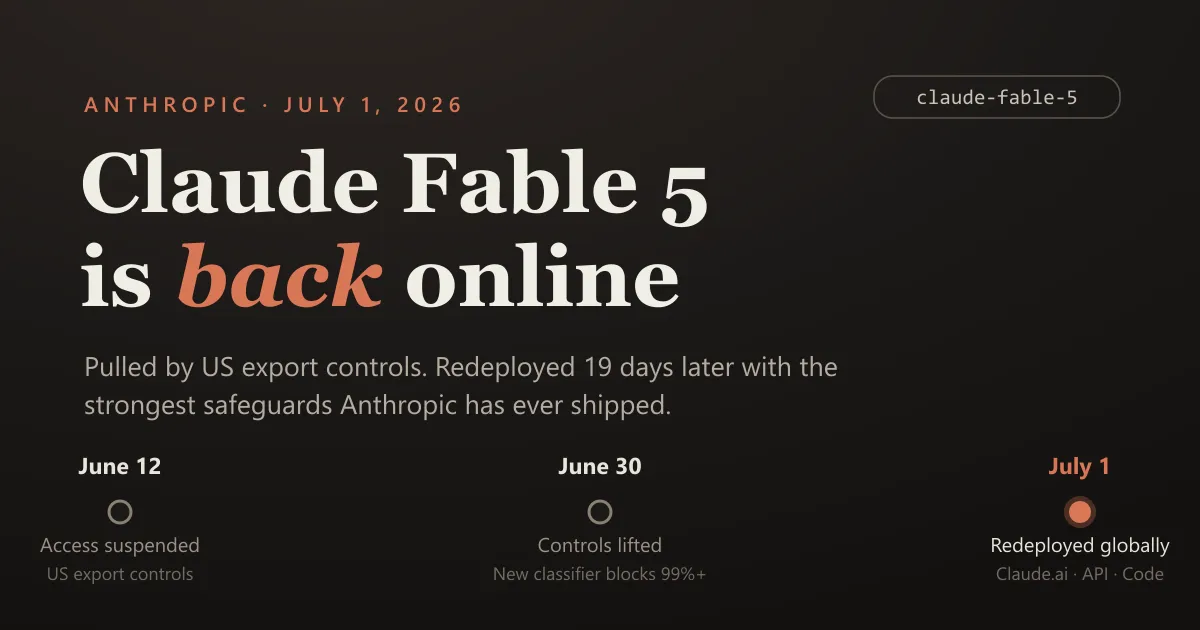
Claude Fable 5 is back. On July 1, 2026, Anthropic redeployed its most capable generally available model worldwide — nineteen days after US export controls forced it offline for every user on the planet. The redeployment announcement is unusually candid for a frontier-lab blog post: it names the jailbreak that started the crisis, publishes the comparative testing that ended it, and proposes an industry-wide framework so the next incident doesn’t take a state-of-the-art model off the market for three weeks.
This article breaks down the full timeline, why the suspension happened, what actually changed in the safeguards, what it costs to use Fable 5 now, and — because model availability just became a production risk category — what engineering and QA teams should take away from the whole episode.
Key takeaways
- Claude Fable 5 is globally available again as of July 1, 2026 on the Claude Platform (API), Claude.ai, Claude Code, and Claude Cowork, after US export controls were lifted on June 30.
- The suspension began on June 12, 2026, when export controls required Anthropic to restrict access by foreign nationals — and with no reliable real-time nationality verification, Anthropic pulled access for everyone rather than risk non-compliance.
- The trigger was a jailbreak discovered by Amazon researchers that prompted Fable 5 to identify software vulnerabilities and, in one case, produce exploit demonstration code.
- Anthropic’s comparative testing found the technique exposed no unique capability: Claude Opus 4.8, GPT-5.5, and Kimi K2.7 could identify the same vulnerabilities, and every model tested reproduced the same exploitation demo.
- Fable 5 returns with a new safety classifier that blocks the reported technique in over 99% of cases; blocked requests notify the user and reroute to Claude Opus 4.8. The US Center for AI Standards and Innovation called the safeguards “extraordinarily strong.”
- Anthropic, with Amazon, Microsoft, Google, and other Project Glasswing partners, proposed a four-criteria jailbreak severity framework — capability gain, breadth, ease of weaponization, and discoverability — to standardize how the industry and governments respond to future discoveries.
- For teams building on frontier models, the lesson is structural: a model can vanish overnight for reasons that have nothing to do with your code. Fallback paths are no longer optional architecture.
Table of Contents
- What happened to Claude Fable 5? The 30-second version
- The full timeline
- Why was Fable 5 suspended?
- Why regulators let it come back
- What changed: the new safeguards
- Availability and pricing
- Fable 5 vs Mythos 5: what’s the difference?
- What API developers need to know
- A proposed standard for judging jailbreaks
- What this means for engineering and QA teams
- Frequently asked questions
- Conclusion
What happened to Claude Fable 5? The 30-second version
Claude Fable 5 was suspended globally on June 12, 2026, after the US government applied export controls to it and its restricted sibling, Claude Mythos 5. The controls followed a report from Amazon researchers describing a jailbreak that bypassed Fable 5’s cybersecurity safeguards. The controls were lifted on June 30 after testing showed the technique granted no capability beyond what less-restricted models already provide, and Fable 5 was redeployed worldwide on July 1 with an upgraded safety classifier that blocks the reported technique in more than 99% of cases.
That’s the summary. The details are worth your time, because almost every part of this story — the trigger, the government response, the comparative testing, the fix — is a preview of how frontier-model incidents will be handled from now on.
The full timeline
| Date (2026) | Event |
|---|---|
| Pre-June 12 | Amazon researchers discover a jailbreak that bypasses Fable 5’s safeguards, prompting it to identify software vulnerabilities and produce exploit demonstration code in one case |
| June 12 | US government applies export controls to Claude Fable 5 and Claude Mythos 5 with immediate effect; Anthropic suspends access globally for all users |
| June 26 | Government approval restores Claude Mythos 5 access for a set of US organizations in Project Glasswing |
| June 30 | Export controls officially lifted; Anthropic publishes “Redeploying Fable 5” with its comparative-testing results and new safeguards |
| July 1 | Fable 5 redeployed globally on the Claude Platform, Claude.ai, Claude Code, and Claude Cowork |
| Through July 7 | Pro, Max, Team, and select Enterprise plans include Fable 5 for up to 50% of weekly usage limits |
| After July 7 | Fable 5 accessible via usage credits on those plans; cloud-provider access (AWS, Google Cloud, Microsoft Foundry) resuming “as quickly as possible” |
Why was Fable 5 suspended?
Two things collided: a jailbreak report and an export-control regime with no tolerance for partial compliance.
The jailbreak. Researchers at Amazon found a technique that bypassed Fable 5’s cybersecurity safeguards. Using it, they could prompt the model to identify software vulnerabilities — and in one demonstrated case, produce code showing how to exploit a specific vulnerability. Cyber capability is exactly the domain where Anthropic drew its hardest lines for the Claude 5 generation, so a published bypass was always going to draw scrutiny.
The export controls. On June 12, the US government responded by applying export controls to both Fable 5 and Mythos 5, requiring Anthropic to restrict access by foreign nationals both inside and outside the United States. The directive took immediate effect. Here’s the operationally interesting part: Anthropic had no reliable way to verify user nationality in real time — no frontier lab does — so the only compliant move was to suspend access for all users, globally. American users lost access not because the government demanded it, but because identity infrastructure couldn’t keep up with a legal requirement that arrived overnight.
If you build software for a living, that failure mode should feel familiar. It’s a dependency outage — except the dependency was the most capable AI model on the market, and the root cause was regulatory, not technical.
Why regulators let it come back
The case for redeployment rested on a question that sounds simple but rarely gets tested rigorously: did the jailbreak actually unlock anything unique?
Anthropic’s answer, backed by comparative testing, was no:
- Many less capable models could identify the same vulnerabilities — Anthropic names Claude Opus 4.8, GPT-5.5, and Kimi K2.7 specifically.
- Every model tested could produce the same vulnerability-exploitation demonstration that the Amazon researchers elicited from Fable 5.
- The researchers’ reported technique, in Anthropic’s words, “did not expose any unique Mythos-level cyber capabilities” — it was “a borderline case for Fable 5’s safeguards,” not a hole in the dam.
That distinction matters. A jailbreak that makes a model say something it shouldn’t is a policy problem. A jailbreak that gives attackers capability they couldn’t get anywhere else is a proliferation problem. The June incident was treated — initially — like the second kind, and turned out on inspection to be the first kind. The government’s own reviewers at the Center for AI Standards and Innovation tested both the previous and the new safeguards and judged them “extraordinarily strong,” and the controls came off on June 30.
The gap between those two categories — and the three weeks of global downtime spent figuring out which one applied — is exactly what Anthropic’s proposed severity framework (below) is designed to close.
What changed: the new safeguards
Fable 5 didn’t come back unchanged. Anthropic shipped a targeted upgrade to its safety stack:
- A new classifier tuned to the reported bypass. It blocks the technique described in the Amazon report in over 99% of cases.
- Notification plus fallback, not a dead end. When a request trips the classifier, the user is told the request was blocked — and the request is rerouted to Claude Opus 4.8 instead of simply failing. You lose the frontier model for that request, not the answer.
- Defense in depth, not a single gate. Anthropic layers multiple mechanisms — classifiers watching inputs and outputs, model-level training, and monitoring — so no single bypass takes down the whole safety story.
- A deliberately wide safety margin. This is the most consequential design choice for real users: Anthropic sets Fable 5’s classifiers to trigger on requests it knows are likely benign. A request has to look very clearly safe to pass. For Fable 5 the margin was widened significantly compared to prior releases — accepting more false positives on legitimate work as the price of blocking harmful outputs.
Anthropic is also realistic about the ceiling here, stating plainly that it is “probably impossible to make any AI model fully robust (that is, impervious) to jailbreaks.” The strategy isn’t perfection; it’s making bypasses rare, low-value, and quickly patchable — and backing that with a new HackerOne program where security researchers can submit potential cyber jailbreaks they discover in Fable 5.
Availability and pricing
Here’s where and how you can use Fable 5 as of this week:
| Channel | Status |
|---|---|
| Claude.ai, Claude Code, Claude Cowork | Live globally from July 1, 2026 |
| Claude Platform (API) | Live globally, model ID claude-fable-5 |
| Pro / Max / Team / select Enterprise plans | Included for up to 50% of weekly usage limits through July 7; via usage credits after |
| AWS, Google Cloud, Microsoft Foundry | Being re-enabled “as quickly as possible” |
| Claude Mythos 5 | Restored June 26 for a set of US organizations in Project Glasswing; broader domestic and international expansion in coordination with the US government |
On the API, Fable 5 sits above the Opus tier on pricing: $10 per million input tokens and $50 per million output tokens, with a 1-million-token context window and up to 128K output tokens per request. That’s 2× Opus 4.8 on both input and output, which keeps the economics simple: Fable 5 is for the work Opus can’t do, not a default upgrade for everything.
Fable 5 vs Mythos 5: what’s the difference?
The two models share the same underlying system — the difference is entirely in who can access them and what safeguards sit in front of them:
| Claude Fable 5 | Claude Mythos 5 | |
|---|---|---|
| Access | Generally available (Claude.ai, API, Claude Code) | Trusted Project Glasswing partners only |
| Cyber capability exposed | Heavily restricted — “the strongest safeguards we’ve ever applied to a model” | Can identify and exploit software vulnerabilities better than any other model, and all but the most skilled human experts |
| Intended use | General frontier-model work: reasoning, long-horizon agents, knowledge work | Defensive cybersecurity only |
| Oversight | Anthropic safety stack + public HackerOne program | Government-coordinated partner vetting |
This split is the whole reason the June incident was resolvable. The question was never “is Fable 5 dangerous?” in the abstract — it was “does this jailbreak turn Fable 5 into Mythos 5?” The comparative testing said no, and that’s what brought it back.
What API developers need to know
If you’re integrating claude-fable-5, the redeployment mechanics show up directly in your request handling. Four things to build for:
1. Refusals are a response state, not an error. When a safety classifier declines a request, you get a successful HTTP 200 with stop_reason: "refusal" — potentially with an empty content array. Code that reads response.content[0] unconditionally will break on refused requests. Check the stop reason first.
2. Fallbacks are opt-in on the API. The automatic “reroute to Opus 4.8” behavior that consumer surfaces like Claude.ai ship by default is available to API callers via the server-side fallbacks beta — but you have to ask for it:
response = client.beta.messages.create(
    model="claude-fable-5",
    max_tokens=16000,
    betas=["server-side-fallback-2026-06-01"],
    fallbacks=[{"model": "claude-opus-4-8"}],
    messages=[{"role": "user", "content": prompt}],
)

if response.stop_reason == "refusal":
    # The whole chain declined — surface it, don't retry blindly
    handle_refusal(response.stop_details)
With fallbacks configured, a classifier decline is transparently re-served by Opus 4.8 inside the same call, with repricing applied automatically. Without it, the request just stops.
3. Expect false positives on security-adjacent work. Remember the safety-margin design: the classifier is deliberately tuned to block some benign requests, and it’s specifically watching cybersecurity-shaped prompts. If your team does legitimate security work — vulnerability triage, penetration-test tooling, security code review — some of those requests will trip the classifier. That’s working as designed, and it’s exactly why the fallback path matters: Opus 4.8 handles most security-tooling work without the Fable-tier restrictions.
4. The operational profile is unchanged. Thinking is always on (omit the thinking parameter — an explicit “disabled” is rejected), the tokenizer matches Opus 4.8, and Fable 5 requires 30-day data retention — organizations on zero-data-retention agreements get a 400 on every request. None of this changed with the redeployment, but if your integration predates June 12, re-run your smoke tests before flipping traffic back.
A proposed standard for judging jailbreaks
The most forward-looking part of the announcement isn’t about Fable 5 at all. Anthropic — jointly with Amazon, Microsoft, Google, and other Project Glasswing partners — proposed a consensus framework for assessing jailbreak severity, built on four criteria:
- Capability gain — how far beyond existing, publicly available tools does the jailbreak actually take a user?
- Breadth of capability gain — does the technique unlock one narrow task, or many distinct offensive tasks?
- Ease of weaponization — how much human skill and effort is needed to turn the jailbreak into a real attack?
- Discoverability — how easily could someone else find or reproduce the technique?
Run the June incident through that rubric and the outcome is obvious in hindsight: capability gain near zero (three other models did the same thing), narrow breadth, meaningful weaponization effort, and a technique that was responsibly reported rather than circulating in the wild. Under a shared framework, that profile probably doesn’t justify a global three-week suspension of a flagship model.
Alongside the framework, Anthropic committed to four expanded areas of collaboration with the US government: pre-release access to models with national-security-relevant capabilities, rapid information sharing when significant jailbreaks or misuse patterns emerge, dedicated research resources (including compute for government testing), and joint development of voluntary industry security standards. Whether or not you care about AI policy, this is the template other labs will be measured against after their own incidents.
What this means for engineering and QA teams
Strip away the policy drama and the June incident is a case study in a new kind of production risk: frontier-model availability is now a regulatory variable, not just an uptime variable.
Three practical takeaways for teams shipping on top of these models:
- Treat model access like any other external dependency — because it failed like one. Fable 5 went from fully available to globally offline in a day, through no fault of any customer’s architecture. If your product has a hard dependency on a single frontier model with no tested degradation path, you now have a documented precedent for why that’s a gap. Wire up fallbacks (server-side where available, application-level otherwise) and actually test the degraded path — the same discipline you’d apply to any third-party API contract.
- Test refusal handling as a first-class scenario. A classifier decline returns HTTP 200 with an empty or partial body. That’s precisely the shape of response that slips past test suites asserting only on status codes. Add explicit cases: refused request, mid-stream refusal, fallback engaged, fallback also refused.
- Expect the safety margin in your security workflows. As we’ve written before, AI in testing workflows is strongest when its failure modes are known and checked. Fable 5’s failure mode on security-adjacent prompts is a deliberate false positive. Route security-tooling tasks to Opus 4.8 by default, reserve Fable 5 for the deep reasoning work it’s priced for, and you’ll avoid most classifier friction entirely.
Frequently asked questions
Why was Claude Fable 5 suspended?
On June 12, 2026, the US government applied export controls to Claude Fable 5 and Claude Mythos 5, requiring Anthropic to restrict access by foreign nationals. Because the directive took immediate effect and no reliable real-time nationality verification exists, Anthropic suspended access for all users globally. The controls followed Amazon researchers’ discovery of a jailbreak that bypassed Fable 5’s cybersecurity safeguards.
When did Claude Fable 5 come back?
US export controls were lifted on June 30, 2026, and Anthropic redeployed Fable 5 globally on July 1, 2026 across Claude.ai, the Claude Platform (API), Claude Code, and Claude Cowork. Cloud-provider access on AWS, Google Cloud, and Microsoft Foundry is being re-enabled on a fast-follow basis.
What was the Claude Fable 5 jailbreak?
Amazon researchers found a technique that bypassed Fable 5’s safeguards, prompting the model to identify software vulnerabilities — including one case where it produced code demonstrating how to exploit a specific vulnerability. Anthropic’s follow-up testing showed the technique exposed no unique capability: Claude Opus 4.8, GPT-5.5, and Kimi K2.7 could identify the same vulnerabilities, and every model tested reproduced the same exploitation demo.
Is Claude Fable 5 safe to use now?
Fable 5 returned with a new safety classifier that blocks the reported jailbreak technique in over 99% of cases, layered on top of what Anthropic calls the strongest safeguards it has ever applied to a model. The US Center for AI Standards and Innovation independently tested both the previous and new safeguards and described them as “extraordinarily strong.” Blocked requests notify the user and reroute to Claude Opus 4.8.
How much does Claude Fable 5 cost?
On the API, Claude Fable 5 costs $10 per million input tokens and $50 per million output tokens — twice Opus 4.8 pricing. On subscription plans, Pro, Max, Team, and select Enterprise users get Fable 5 included for up to 50% of weekly usage limits through July 7, 2026, and via usage credits after that.
What is the difference between Claude Fable 5 and Claude Mythos 5?
They share the same underlying model. Fable 5 is the generally available version with heavy cybersecurity safeguards. Mythos 5 exposes the full capability set — including vulnerability discovery and exploitation that exceeds all but the most skilled human experts — and is restricted to vetted Project Glasswing partners for defensive cybersecurity work only.
What happens when Fable 5 blocks my request?
On consumer surfaces (Claude.ai, Claude Code), you’re notified and the request is automatically rerouted to Claude Opus 4.8. On the API, a blocked request returns HTTP 200 with stop_reason: "refusal" — and fallback to Opus 4.8 is opt-in via the server-side fallbacks beta, so unhandled refusals will simply stop unless your code accounts for them.
Can I use Claude Fable 5 for security testing?
Legitimate security work can trip Fable 5’s classifiers by design — Anthropic deliberately widened the safety margin, accepting more false positives on benign security-adjacent requests. For vulnerability triage, pentest tooling, and security code review, Claude Opus 4.8 handles most workloads without Fable-tier restrictions, which is why it’s also the recommended fallback model.
Conclusion
The headline is that Claude Fable 5 is back. The story underneath is more interesting: the industry just ran its first full-cycle drill of a frontier-model security incident — discovery, government intervention, comparative capability testing, targeted mitigation, independent verification, and redeployment — in nineteen days. The proposed jailbreak severity framework exists so the next cycle doesn’t need export controls to get started, and the expanded government collaboration means the next evaluation happens before launch, not after a suspension.
For builders, the takeaway is less philosophical: the most capable model on the market disappeared for three weeks and came back with a classifier that intentionally blocks some legitimate requests. Both of those are now permanent features of the frontier-AI landscape. Architect for them — fallback models, tested refusal paths, routing that matches each task to the least-restricted model that can do it — and incidents like June become a line item in your risk register instead of an outage post-mortem.
Source: This article summarizes and analyzes Anthropic’s official announcement, Redeploying Fable 5, published June 30, 2026 and updated July 1, 2026. Timeline details, quotes, testing claims, and availability terms are as reported by Anthropic and are subject to change — check the source for the latest.
Written by Abhay Kumar — QA engineer and creator of OrbitTest, building practical tools for browser, mobile, and API testing. Browse more AI & Engineering articles.