Claude Sonnet 5 is Anthropic’s latest mid-tier model, and the pitch is unusually direct: agentic coding and reasoning performance that closes most of the distance to Opus-tier quality, sold at Sonnet-tier prices. That’s a meaningful claim — the gap between “cheap enough to run at scale” and “good enough to trust with real autonomy” has been the defining tension in production AI for the last two years.
This article breaks down what actually shipped, what the benchmarks say, what it costs, and where it fits if you’re building or testing software with it.
Key takeaways
- Claude Sonnet 5 is described by Anthropic as the most agentic Sonnet model yet — it plans, uses tools like browsers and terminals, and runs autonomously for longer stretches than Sonnet 4.6.
- At medium effort, Anthropic reports better cost-efficiency than Opus 4.8; at higher effort, it can match Opus 4.8 on some tasks.
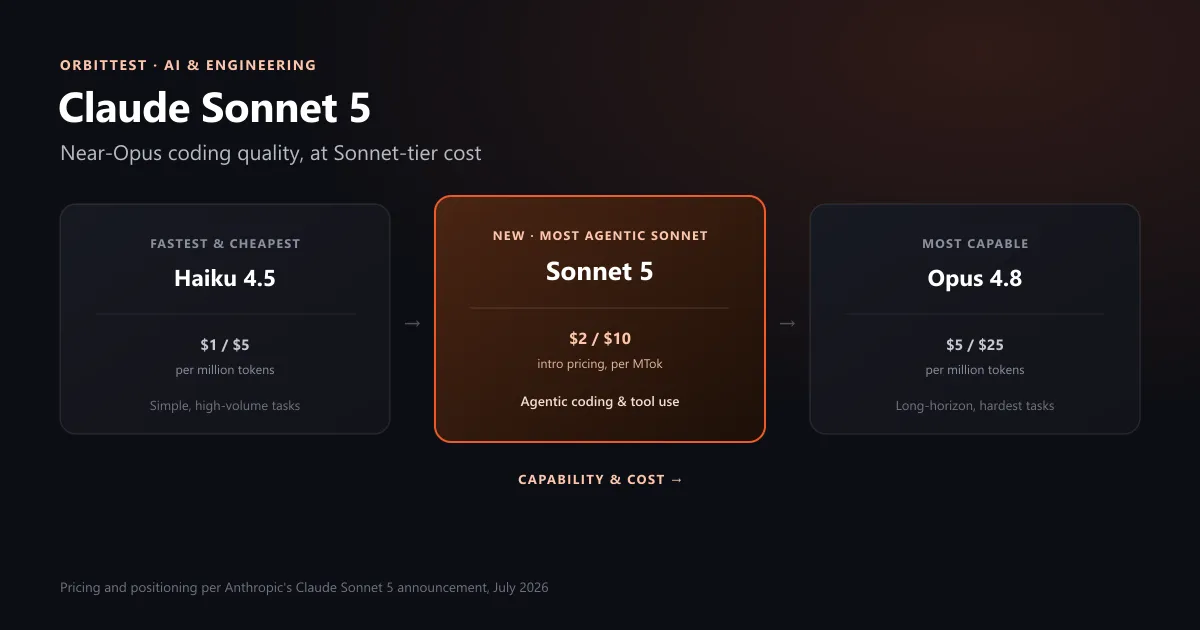
- Introductory pricing runs through August 31, 2026: $2 / $10 per million input/output tokens, stepping up to $3 / $15 afterward.
- It’s the default model for Free and Pro users on Claude, and available across every paid tier and the API as
claude-sonnet-5. - Safety metrics moved in the right direction too: lower hallucination and sycophancy rates, better prompt-injection resistance, and cyber safeguards enabled by default.
- For engineering and QA teams, the practical implication isn’t “the model is smarter” — it’s that more autonomous code and more autonomous PRs are coming faster, which raises the bar on verification, not lowers it.
Table of Contents
- What is Claude Sonnet 5?
- What’s actually new
- Benchmarks: how much better is it than Sonnet 4.6?
- Pricing
- Technical specs at a glance
- Safety and reliability improvements
- Claude Sonnet 5 vs Opus 4.8 vs Haiku 4.5
- Early real-world use cases
- What this means for engineering and QA teams
- Frequently asked questions
- Conclusion
What is Claude Sonnet 5?
Claude Sonnet 5 is the newest release in Anthropic’s Sonnet line — the mid-tier model positioned between the fast, low-cost Haiku models and the flagship Opus models. It follows Sonnet 4.6, and it’s shipped alongside Opus 4.8 as part of the same generation of Claude models.
The headline framing from Anthropic is simple: this is the most agentic Sonnet model yet. That word — agentic — is doing a lot of work in this release. It means the model is built and tuned to make plans, decide which tools to reach for (browsers, terminals, code execution, file editors), execute multi-step work with less hand-holding, and keep going instead of stopping to ask permission for every small decision. Those are exactly the capabilities that separate “a good autocomplete” from “something you can point at a Jira ticket and walk away from.”
What’s actually new
Compared to Sonnet 4.6, Anthropic calls out a specific, practical set of improvements rather than a vague “it’s smarter now”:
- It finishes what it starts. Where Sonnet 4.6 would often stop and hand control back mid-task, Sonnet 5 pushes through to completion on tasks that require multiple dependent steps.
- It self-checks without being told to. Verification — re-reading its own output, checking that a change didn’t break something else — happens by default, not because the prompt asked for it.
- It gets there in fewer steps. For agentic, tool-heavy workflows, that matters for cost as much as speed — fewer round trips means fewer tokens spent re-establishing context.
- Reasoning, tool use, coding, and knowledge work are all up — precisely the areas where prior Sonnet models were “good enough for most things, not the hard stuff.”
Benchmarks: how much better is it than Sonnet 4.6?
Anthropic reports substantial gains over Sonnet 4.6, particularly in agentic search and computer use evaluations — the categories that measure whether a model can operate a real environment (a browser, a terminal, a file system) rather than just answer a question in isolation.
The more interesting comparison is against Anthropic’s own flagship: at medium effort, Sonnet 5 is positioned as more cost-efficient than Opus 4.8 for comparable quality; at higher effort, it can match Opus 4.8 on specific tasks. That’s the core positioning of this release — instead of “Sonnet is cheap, Opus is good,” the line between them has moved. You dial Sonnet 5 up when a task deserves it and back down when it doesn’t, without switching models.
Pricing
Claude Sonnet 5 ships with introductory pricing that runs through August 31, 2026:
| Introductory (through Aug 31, 2026) | Standard (after) | |
|---|---|---|
| Input | $2 / MTok | $3 / MTok |
| Output | $10 / MTok | $15 / MTok |
It’s available across Free, Pro, Max, Team, and Enterprise plans, and it’s the default model for Free and Pro users — which is a strong signal of how confident Anthropic is in its cost profile at scale. For API access, the model ID is simply claude-sonnet-5.
Technical specs at a glance
For teams building against the API, here’s what changed under the hood:
| Spec | Claude Sonnet 5 |
|---|---|
| API model ID | claude-sonnet-5 |
| Context window | 1,000,000 tokens |
| Max output | 128,000 tokens |
| Extended thinking | Adaptive, on by default |
| Effort levels | low, medium, high (default), xhigh, max |
| Vision resolution | Up to 2,576px on the long edge (up from 1,568px on Sonnet 4.6) |
| Sampling params | Non-default temperature / top_p / top_k are rejected |
Two things matter most if you’re migrating existing code rather than starting fresh. First, manual extended-thinking budgets (budget_tokens) are gone — thinking is adaptive and runs by default, which changes output length and cost if your code assumed thinking was off. Second, the tokenizer changed: the same input text produces roughly 30% more tokens than on Sonnet 4.6, so cost estimates and context budgets built against the old model need re-measuring, not just re-labeling.
Safety and reliability improvements
Capability gains without safety regressions is the harder trick, and Anthropic’s release notes lean into this explicitly:
- Lower hallucination and sycophancy rates than Sonnet 4.6.
- Better at refusing malicious requests and more resistant to prompt injection — relevant for anyone deploying agents that read untrusted input (web pages, emails, files) as part of their tool loop.
- Cyber safeguards enabled by default. The model was substantially weaker than Opus 4.8 at exploit development and never produced a full working exploit in Firefox vulnerability testing — a deliberate ceiling, not an oversight.
- Lower overall rate of undesirable behaviors compared to its predecessor.
More autonomy held to a tighter safety bar is the same tension every team building on these models has to manage internally. A model that does more without asking also needs more guardrails around what “more” is allowed to include.
Claude Sonnet 5 vs Opus 4.8 vs Haiku 4.5
If you’re deciding which model to point a workload at, this is the practical breakdown:
| Haiku 4.5 | Sonnet 5 | Opus 4.8 | |
|---|---|---|---|
| Best for | High-volume, simple tasks | Agentic coding, sustained multi-step work | Long-horizon, hardest reasoning tasks |
| Relative cost | Lowest | Mid, near-Opus quality at higher effort | Highest |
| Autonomy | Low | High | Highest |
| Typical use | Classification, extraction, quick Q&A | PR automation, debugging, tool-heavy agents | Deep research, overnight autonomous runs |
The practical rule of thumb: default to Sonnet 5 for anything involving real tool use or multi-step execution — coding agents, PR workflows, judgment-heavy pipelines. Reach for Opus 4.8 when the task is genuinely open-ended and errors are expensive. Keep Haiku 4.5 for the high-volume, low-judgment layer — routing, quick classification, the thing you call a thousand times a day.
Early real-world use cases
Anthropic’s early access partners reported success with a consistent shape of task — long enough to need real planning, concrete enough to verify:
- Multi-step software engineering — sustained coding sessions rather than single-file edits.
- End-to-end automation, such as updating records in Salesforce and firing off the resulting notifications.
- Pull request handling carried through to a tested, verified completion — not just a diff, but a diff that’s been checked.
- Brownfield debugging — root-causing issues in existing, unfamiliar codebases, a harder problem than writing new code from a clean prompt.
- Legal research and analysis, and real-time data exploration for generating insights on the fly.
The common thread is autonomy over a bounded but multi-step task — a meaningfully different bar than “answer this one question well.”
What this means for engineering and QA teams
Here’s the part that matters beyond the press release: every gain in agentic autonomy is also a gain in the volume of unsupervised output your team now has to trust. If Sonnet 5 really does carry a PR through to “tested, verified completion” on its own, the natural next question is: verified by what standard, and who’s checking the checker?
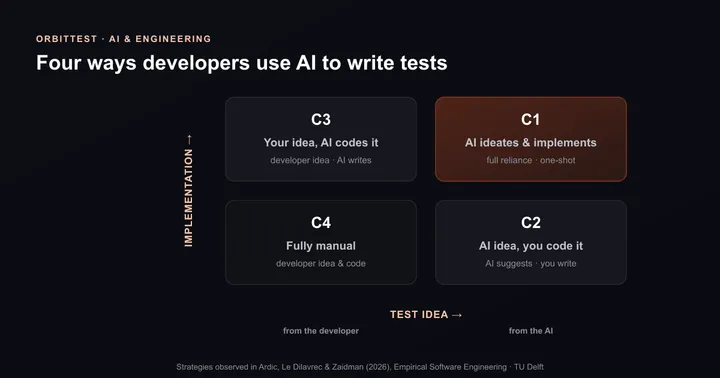
This isn’t a knock on the model — it’s the same dynamic we’ve written about before. AI is consistently strong at generating test ideas and consistently weak at getting the exact expected value right — a subtly wrong assertion that still compiles and still looks plausible is far more dangerous than an obviously broken one. Scale up the model’s autonomy and you scale up both sides of that equation: more legitimate work shipped, and more plausible-looking mistakes that need a second system to catch.
If your team is adopting Sonnet 5 for coding agents or PR automation, tighten the verification layer at the same rate you loosen the generation layer — real test coverage, real API contract checks, and CI gates that check “did it produce the right answer,” not just “did it run.”
Frequently asked questions
What is Claude Sonnet 5?
Claude Sonnet 5 is Anthropic’s newest mid-tier Claude model, positioned between Haiku 4.5 and Opus 4.8. Anthropic describes it as the most agentic Sonnet model yet, with substantial gains in coding, tool use, and multi-step autonomous execution over Sonnet 4.6.
How much does Claude Sonnet 5 cost?
Introductory pricing through August 31, 2026 is $2 per million input tokens and $10 per million output tokens. After that date, standard pricing applies at $3 per million input tokens and $15 per million output tokens.
What is the context window of Claude Sonnet 5?
Claude Sonnet 5 has a 1 million token context window and supports up to 128,000 tokens of output per request.
Is Claude Sonnet 5 better than Claude Opus 4.8?
It depends on effort level and task. At medium effort, Sonnet 5 offers better cost-efficiency than Opus 4.8 for comparable quality. At higher effort settings, it can match Opus 4.8 on specific tasks, though Opus 4.8 remains the more capable model for the hardest, longest-horizon work.
How do I access Claude Sonnet 5 via the API?
Use the model ID claude-sonnet-5 with the Claude API. It supports adaptive extended thinking (on by default), effort levels from low to max, and the same tool-use and vision capabilities as other current-generation Claude models.
Is Claude Sonnet 5 available for free?
Yes. It’s the default model for Free and Pro users on Claude, and it’s also available on Max, Team, and Enterprise plans, as well as through the API.
Conclusion
Claude Sonnet 5 isn’t a headline-grabbing leap in raw intelligence — it’s Anthropic narrowing the gap between “affordable” and “trustworthy enough to run on its own,” the harder and more commercially important problem. Faster, more autonomous coding agents are coming either way. The teams that benefit are the ones pairing that autonomy with equally serious verification, not the ones pointing it at production and hoping the plausible-looking output is also the correct one.
Source: This article summarizes and analyzes Anthropic’s official announcement, Claude Sonnet 5, published by Anthropic. Pricing, benchmark claims, and safety figures referenced above are as reported by Anthropic at launch and are subject to change — check the source for the latest figures.
Written by Abhay Kumar — QA engineer and creator of OrbitTest, building practical tools for browser, mobile, and API testing. Browse more AI & Engineering articles.