Every backend and QA engineer has lived this loop. A new API endpoint ships, you get a sample JSON response, and now you need a Java class that matches it — field by field, type by type, nested object by nested object. So you start hand-typing: private Long id;, private String name;, a @JsonProperty here for the snake_case key, a List<> there for the array. Twenty minutes later you have a User class, three nested classes, and a nagging feeling you got one of the date types wrong.
Then the reverse happens. Someone asks, “What does the /orders endpoint actually return?” You open the JPA entity, see @OneToMany, @ManyToOne, a BaseEntity superclass, and a bidirectional relationship — and you genuinely cannot tell what JSON Jackson will produce without booting the whole application.
Both problems are the same problem: converting between JSON and Java is mechanical, but doing it by hand is slow and error-prone. This guide shows how to automate both directions, what the tricky cases are, and how to get it right the first time.
Table of Contents
- Why Converting Between JSON and Java Is Such a Time Sink
- What Is a POJO, and Why Generate One From JSON?
- How to Convert JSON to a Java POJO
- The Reverse: What JSON Does My JPA Entity Return?
- Best Practices
- Common Mistakes
- Frequently Asked Questions
- Conclusion
Why Converting Between JSON and Java Is Such a Time Sink
The conversion itself is simple in theory — a string is a String, a number is an int. The cost hides in the details:
- Type ambiguity. Is
"2026-06-29"aStringor aLocalDate? Is1024.50adoubleor aBigDecimalfor monetary precision? JSON doesn’t say; you have to decide. - Naming conventions. APIs love
snake_case(postal_code), Java wantscamelCase(postalCode). Bridging them correctly means a@JsonPropertyon every mismatched field. - Nesting and arrays. Each nested object becomes its own class; each array becomes a
List<T>whose element type you have to infer from possibly inconsistent items. - Relationships and cycles. On the Java side, a bidirectional
@OneToMany/@ManyToOnepair will serialize into an infinite loop unless you break it.
None of this is hard. All of it is tedious — and tedium is where bugs and wasted hours live. The fix is to let a tool do the mechanical part so you only review the result.
What Is a POJO, and Why Generate One From JSON?
A POJO (Plain Old Java Object) is an ordinary Java class with fields and accessors and no framework-specific base class. When you consume a JSON API in Java, you map the response onto a POJO so a library like Jackson can deserialize it into typed objects you can work with safely.
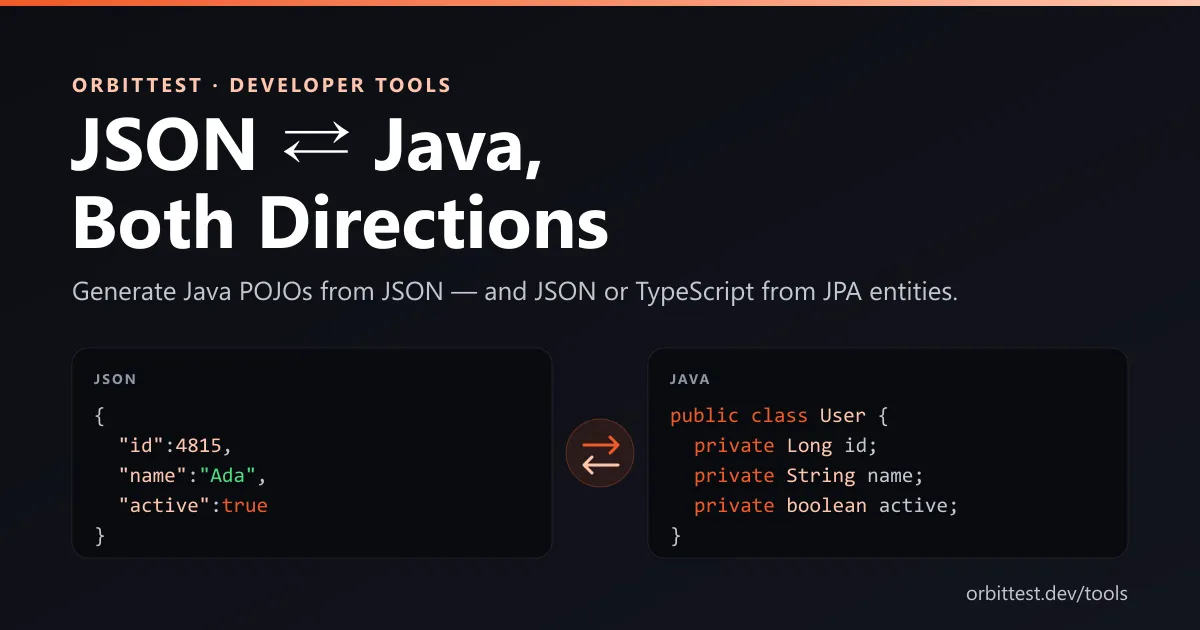
Generating that POJO from a JSON sample means you never hand-type the boilerplate. Paste the payload into a JSON to Java POJO generator, choose a style, and you get compile-ready classes. The tool infers a Java type for every value, turns nested objects into classes, arrays into List<T>, and preserves the original JSON keys with @JsonProperty when they differ from the camelCase field name.
How to Convert JSON to a Java POJO
Say you receive this response:
{
  "id": 4815,
  "name": "Ada Lovelace",
  "createdAt": "2026-06-29T12:00:00Z",
  "postal_code": "EC1A 1BB",
  "orders": [ { "orderId": 1, "total": 99.99 } ]
}
A good generator turns it into idiomatic Java — here in Lombok style:
import com.fasterxml.jackson.annotation.JsonProperty;
import java.time.Instant;
import java.util.List;
import lombok.Data;

@Data
public class User {
    private int id;
    private String name;
    private Instant createdAt;
    @JsonProperty("postal_code")
    private String postalCode;
    private List<Order> orders;
}

@Data
public class Order {
    private int orderId;
    private double total;
}
Notice what was inferred automatically: createdAt became an Instant (the trailing Z signals UTC), postal_code was mapped to a postalCode field with a Jackson binding, and the orders array produced a separate Order class. You can switch the output to a Java record, plain getters/setters, or fields-only, and toggle BigDecimal for decimals or boxed wrapper types — useful when a field can be null.
If you also want a formal contract for the same payload, pair this with the JSON to JSON Schema generator; and when a response looks malformed, the JSON Formatter pinpoints the broken line first.
The Reverse: What JSON Does My JPA Entity Return?
The other half of the workflow is going from Java to JSON — and this is where most surprises happen. A Java/JPA entity to JSON generator reads your entity classes and shows the JSON (or TypeScript) they serialize to, modelling all four relationship cardinalities:
@OneToOneand@ManyToOne→ a single nested object.@OneToManyand@ManyToMany→ an array of objects.
The classic trap is the bidirectional relationship. A Customer has many Orders, and each Order points back to its Customer. Serialize that naively and Jackson recurses forever until it throws a StackOverflowError. The standard fixes are @JsonManagedReference/@JsonBackReference, marking one side @JsonIgnore, or flattening to ID references (customerId instead of the full object). A good tool detects the cycle and cuts it for you, so you can see the safe shape before you write a single annotation.
Two more details that production codebases always hit: inheritance (entities that extends BaseEntity for id, createdAt, updatedAt — those fields must appear in the JSON) and TypeScript output, so a frontend can be typed against the exact backend model. Both are one click away, which closes the loop between your Java services and the clients that consume them.
Best Practices
- Generate, then review — don’t hand-type. Let the tool produce the skeleton, then adjust the one or two types only you know (e.g.
BigDecimalfor money, an enum for a status string). - Preserve API keys with
@JsonProperty. Never rename your JSON contract to fit Java; bind it instead. - Prefer
Instant/LocalDateoverStringfor dates. Typed time values prevent a whole class of timezone and formatting bugs. - Break relationship cycles deliberately. Decide which side owns the JSON and annotate it; don’t discover the loop in production.
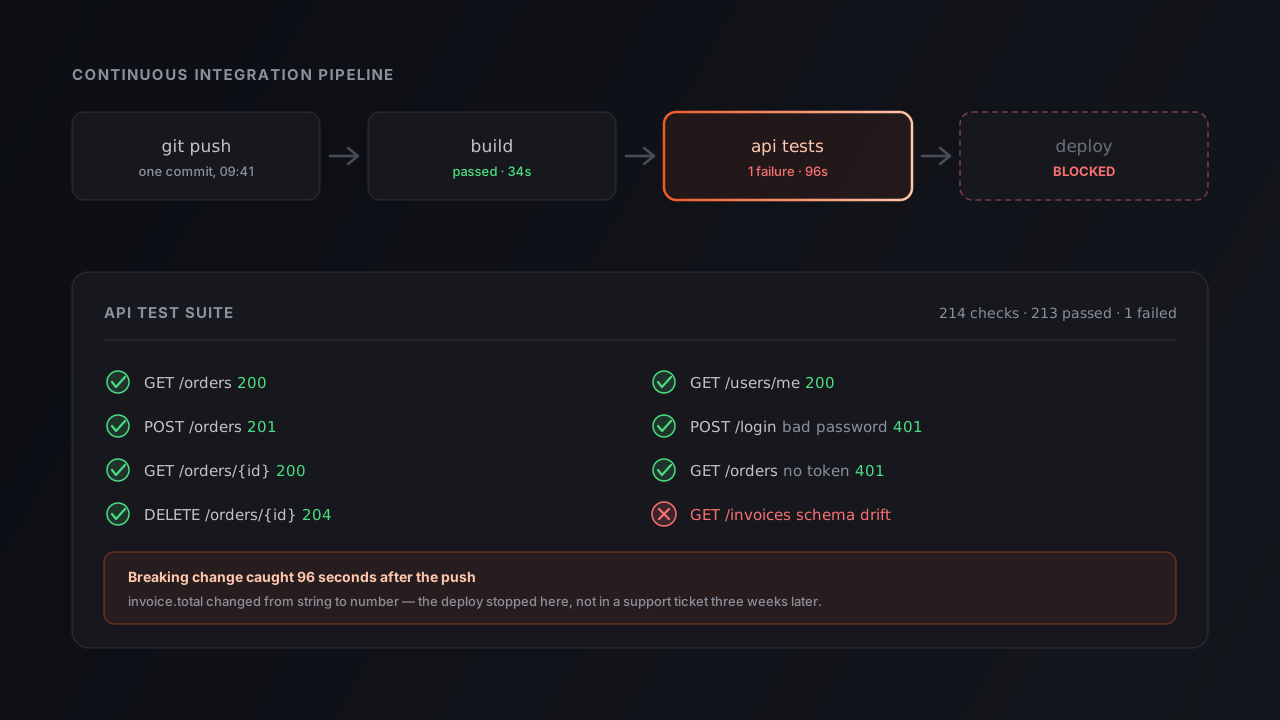
- Re-generate when the contract changes. Treat the generated class as derived, not sacred — and back it with contract testing so drift is caught automatically.
Common Mistakes
- Using
doublefor currency. Floating-point rounding corrupts money — chooseBigDecimal. - Forgetting wrapper types for nullable fields. A JSON
nullcan’t map to a primitiveint; it needsInteger. - Ignoring
snake_casekeys. Without@JsonProperty, deserialization silently leaves fields null. - Serializing entities directly over REST. Exposing JPA entities leaks lazy-loaded relationships and invites cycles; generate a DTO shape instead.
- Pasting proprietary models into unknown sites. Prefer client-side tools that process everything in the browser so your code never leaves your machine.
Frequently Asked Questions
How do I convert JSON to a Java POJO?
Paste your JSON into a JSON-to-POJO generator, pick an output style (Lombok, record, or getters/setters), and copy the generated classes. The tool infers field types, creates nested classes for nested objects, maps arrays to List<T>, and adds @JsonProperty where JSON keys differ from Java field names.
What is the difference between a POJO and a JPA entity?
A POJO is a plain Java class with no framework dependency, typically used to map an API response. A JPA entity is a POJO annotated with @Entity and relationship annotations so it maps to database tables. You generate a POJO from JSON; you generate JSON from a JPA entity.
Can I generate a Java record instead of a class?
Yes. Modern Java records are ideal for immutable data carriers, and the JSON-to-POJO tool can emit record declarations with Jackson bindings instead of a Lombok or getter/setter class.
How are one-to-many and many-to-many relationships represented in JSON?
Both become JSON arrays of objects. @OneToMany and @ManyToMany serialize to a list on the owning side; @OneToOne and @ManyToOne serialize to a single nested object. Bidirectional pairs must break the cycle to avoid infinite recursion.
Is it safe to paste private API responses or entity code?
With OrbitTest’s tools, yes — parsing and generation run entirely in your browser, so nothing is uploaded. As a rule, avoid pasting proprietary code into tools that send data to a server.
Do I need Lombok or Jackson installed to use the output?
Only if you choose those styles. The generator offers plain getters/setters and fields-only output with no dependencies, plus Lombok @Data and Jackson @JsonProperty options when your project already uses them.
Conclusion
Converting between JSON and Java isn’t intellectually hard — it’s just repetitive enough that doing it by hand quietly eats your day and occasionally introduces a bug. Automating both directions removes that friction: generate a Java POJO from any JSON payload, and generate JSON or TypeScript from your JPA entities, with relationships and inheritance handled for you.
Paste, review, copy, ship — and get back to the work that actually needs your judgement. If your day involves APIs, both tools belong in your bookmarks alongside the rest of the free OrbitTest toolkit.
Further reading: Jackson documentation, Project Lombok, Jakarta Persistence (JPA), and Java records (JEP 395).
Written by Abhay Kumar — QA engineer and creator of OrbitTest, building practical tools for browser, mobile, and API testing. Browse more API testing articles.